
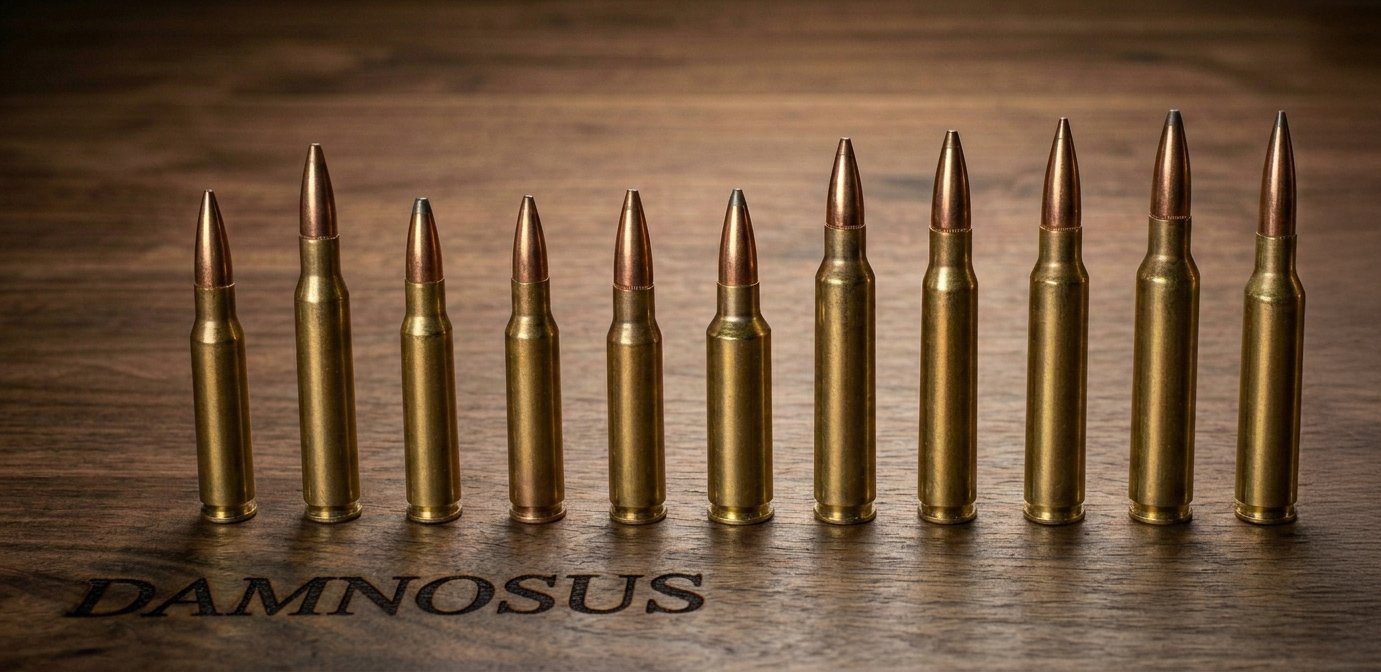
Why .30 Caliber for ELR?
The .30 caliber bore diameter is the practical middle ground for extreme long range shooting. Heavy-for-caliber .30 cal bullets deliver ballistic coefficients competitive with 7.62 mm projectiles while carrying significantly more kinetic energy downrange. The question is which cartridge fits your budget and your target distance.
This comparison covers eleven .30 caliber cartridges from mild to wild: .308 Winchester, .300 WSM, .300 Win Mag, .300 PRC, .300 WSSM, .300 Norma Mag, .300 RSAUM, .300 RUM, .30-378 Weatherby, .30 Nosler, and .300 Lapua Mag. This comparison covers action length, barrel specs, top-tier bullet options, ammunition cost spread, and ballistic performance at the edge of each cartridge's practical envelope.
Understanding the .30 Cal Landscape
The .30 caliber family spans short-action tactical rounds through long-action magnums that push 230-grain bullets past 3,000 fps. Action length determines bolt travel and plays into rifle weight. Short-action cartridges fit lighter platforms but sacrifice case capacity. Long-action magnums demand heavier rifles and more powder but deliver flatter trajectory and reduced wind drift at extended range.
Barrel length and twist rate are not interchangeable across the family. A .308 Win reaches peak velocity in 20–24 inches. A .300 RUM needs 26–28 inches to burn its powder charge efficiently. Twist rate must stabilize the highest-BC bullets available, typically 1:9 or faster for 200+ grain .30 cal projectiles with boat-tail designs and high sectional density.
Cost is the other defining axis. Factory .308 Win starts around $0.60/round for bulk ball ammo and tops out around $3–4/round for premium match-grade loads. Wildcat magnums like .300 WSSM require custom brass and handloading, there is no cheaper range ammo option.
.308 Winchester
Action: Short
Case capacity: 56 grains H2O1
Optimal barrel length: 20–24 inches
Optimal twist rate: 1:10 (175–178gr) or 1:9 (190–200gr)
Top BC bullet: Berger 200.20X Hybrid (G1 BC 0.608, G7 BC 0.313)
Ammo cost: $0.60–1.20/rd bulk, $2.50–3.50/rd match (Federal Gold Medal 175gr SMK, Hornady 178gr ELD-M)
The .308 Winchester is the short-action workhorse. It delivers 2,600 fps with a 175-grain bullet from a 24-inch barrel. With the Berger 200.20X at 2,500 fps, you're looking at roughly 13 mils of drop at 1,000 yards and transonic transition around 1,100–1,200 yards depending on density altitude. Groups open past 1 MOA somewhere between 800 and 1,000 yards with factory match ammo in a quality rifle.
The .308 Win is not an ELR cartridge by raw ballistics. The ammunition cost advantage is real: bulk .308 practice ammo costs half what 6.5 Creedmoor costs and one-fifth what .300 PRC costs. If your goal is learning wind holds and trajectory management without burning money, the .308 Win is the way to go. Barrel life is normally betweeb 5,000 and 8,000 rounds depending on how hard you run it. Brass is cheap and plentiful because of the NATO production of its counterpart the 7.62x51. The .308 Win fits any short-action platform and magazines feed without problem.
.300 WSM
Action: Short (with caveats)
Case capacity: 80 grains H2O2
Optimal barrel length: 24–26 inches
Optimal twist rate: 1:9 or 1:8 (200–225gr)
Top BC bullet: Berger 215 Hybrid (G1 BC 0.696, G7 BC 0.356)3
Ammo cost: $1.20–2.50/rd bulk, $4.50–6.00/rd match (Hornady Precision Hunter 200gr ELD-X, Berger factory 185gr)
The .300 WSM sends a 215-grain Berger downrange at 2,850 fps from a 26-inch barrel. The drop at 1,200 yards is roughly 10.8 mils. Transonic transition happens around 1,400–1,500 yards, so you can stretch out farther than a .308 Win, and even share a chassis with one if your actions are the same brand. The cartridge opens past 1 MOA around 1,000–1,100 yards with match ammo in a well-built rifle.
Barrel life is between 1,200–1,800 rounds. Factory ammo selection is decent but not deep, and typically is geared toward hunting rather than match. The .300 WSM occupies an awkward middle ground. It's a magnum cartridge jammed into a short action footprint, which is kind of cool, but probably not your "Plan A", and not what I would recommend for a first rifle in your collection.
.300 Winchester Magnum
Action: Long
Case capacity: 93 grains H2O4
Optimal barrel length: 24–26 inches
Optimal twist rate: 1:10 (180–200gr) or 1:9 (215–225gr)
Top BC bullet: Berger 215 Hybrid (G1 BC 0.696, G7 BC 0.356)
Ammo cost: $1.00–2.00/rd bulk, $4.00–5.50/rd match (Federal Gold Medal 190gr SMK, Hornady 200gr ELD-X)
The .300 Win Mag is the baseline long-action .30 cal magnum. It pushes the 215 Hybrid to 2,950 fps from a 26-inch barrel. The expected drop at 1,300 yards is roughly 10.2 mils. It hits the transonic zone around 1,500–1,600 yards. Expect groups to open past 1 MOA around 1,100–1,200 yards with quality factory ammo.
The .300 Win Mag has been a standard cartridge for long-range hunting and military precision rifles since the 1960s.5 Ammunition is available everywhere. Brass is cheap. Factory match loads from Federal, Hornady, and Berger are time proven. Barrel life is 1,200–2,000 rounds depending on throat erosion and how hot you run your barrel. But, it's an old out-of-date cartridge that exemplifies "You get what you pay for".
If I was building an ELR rifle from parts, this would not by my choice of calibers, as the ballistics aren't there. If I'm going to pay for a Rem700 long action, and buy a barrel, I'm 0% chance getting it chambered for .300 Win Mag. Now, if you want to accurize one that's been in your family for years, let's go!
.300 PRC
Action: Long
Case capacity: 77 grains H2O
Optimal barrel length: 24–26 inches
Optimal twist rate: 1:9 or 1:8 (200–225gr)
Top BC bullet: Hornady 225gr ELD-M (G1 BC 0.777, G7 BC 0.391 at Mach 2.25)6 or Berger 230 Hybrid (G1 BC 0.743, G7 BC 0.380)
Ammo cost: $2.00–3.00/rd bulk, $5.50–7.00/rd match (Hornady Precision Hunter 212gr ELD-X, Hornady Match 225gr ELD-M)
Hornady designed the .300 PRC specifically for heavy-for-caliber bullets seated to magazine length in a long action.7 It spins the 225 ELD-M to 2,850 fps from a 26-inch barrel. The elevation drop at 1,400 yards is roughly 10.5 mils. The transonic transition happens around 1,600–1,700 yards. Groups open up past 1 MOA around 1,200–1,300 yards.
The case geometry is optimized, with minimal body taper, 30-degree shoulder, and enough neck length to seat long bullets without intruding into the powder column. Factory rifles are chambered with fast-twist barrels (1:8 or 1:9) as a standard. Hornady's factory 225gr ELD-M load is legitimately awesome, it's not hand load quality but it's a huge time savings .
The barrel life is 1,000–1,500 rounds. The .300 PRC runs at higher pressure than .300 Win Mag and the shorter, fatter case generates more throat erosion per round. The brass cost is higher than .300 Win Mag (Hornady is the primary source) but quality is consistent. Unless you're trying to get a 30 cal into 33 cal territory, this is my hands down choice for what you would build first. It has great performing, inexpensive ammunition available, and you can confidently learn to shoot a mile. And don't forget - that's really cool to do.
.300 WSSM
Action: Short
Case capacity: 71 grains H2O
Optimal barrel length: 24 inches
Optimal twist rate: 1:10 (150–180gr)
Top BC bullet: Berger 185 Juggernaut (G1 BC 0.549, G7 BC 0.282), but the cartridge isn't optimized for it
Ammo cost: Factory ammo discontinued; brass $2.00–3.00/pc when available (Graf & Sons, MidwayUSA)
The .300 Winchester Super Short Magnum was part of the WSSM family introduced in the early 2000s and effectively discontinued by 2010. The .300 WSSM case is too short and fat to stabilize heavy .30 cal bullets efficiently. It was designed for 150–220 grain bullets at high velocity. Factory ammo is nearly impossible to find. Brass is also scarce and expensive, but it is a really wild looking cartridge when you see one.
The .300 WSSM appears here for completeness. If you were hell bent on getting one built, I'd say you would probably like a 7 PRC better...
.300 Norma Magnum
Action: Long
Case capacity: 99 grains H2O
Optimal barrel length: 26–28 inches
Optimal twist rate: 1:9 or 1:8 (215–230gr)
Top BC bullet: Berger 230 Hybrid (G1 BC 0.743, G7 BC 0.380)
Ammo cost: $4.00–6.00/rd factory (Berger, limited availability); primarily a handload cartridge; brass $2.00–3.00/pc (Norma, Lapua, Peterson)
The .300 Norma Mag launches the 230 Hybrid to 3,000 fps from a 28-inch barrel. The drop at 1,500 yards is roughly 9.8 mils. Transonic transition is around 1,700–1,800 yards. Groups open past 1 MOA around 1,300–1,400 yards with quality handloads.
The .300 Norma was adopted by SOCOM and has seen increasing use in King of 1 Mile and other ELR competitions.8 The case design is similar to .300 PRC but with more capacity and a slightly different shoulder angle. It delivers .300 Win Mag velocities with heavier bullets or higher velocities with the same bullets.
Barrel life is only 800 to 1,200 rounds, because the cartridge is hard on throats. Factory ammo is limited as only Berger and a few boutique manufacturers make it, but this is primarily a handloader's cartridge. Brass is available from Norma, Lapua, and Peterson, but expect to pay $2–3 per case. The .300 Norma Mag is a serious ELR cartridge for serious shooters willing to handload and replace barrels regularly.
.300 Rem SAUM
Action: Short
Case capacity: 81 grains H2O
Optimal barrel length: 24–26 inches
Optimal twist rate: 1:9 or 1:8 (200–215gr)
Top BC bullet: Berger 215 Hybrid (G1 BC 0.696, G7 BC 0.356)
Ammo cost: Factory ammo scarce (Remington discontinued); primarily a handload cartridge; hunting ammo is $3-4 per round when you can find it.
The .300 Remington Short Action Ultra Mag is ballistically similar to .300 WSM but with a rebated rim that fits standard .473" bolt faces. It sends the 215 Hybrid downrange at 2,850–2,900 fps from a 26-inch barrel. It's performance mirrors .300 WSM, the drop at 1,200 yards is around 10.8 mils, it goes transonic around 1,400–1,500 yards. Groups start opening past 1 MOA around 1,000–1,100 yards. The .300 RSAUM suffers from the same magazine-length issues as .300 WSM when loaded with heavy bullets. Factory ammo is nearly extinct as Remington discontinued most RSAUM loads years ago.
The .300 RSAUM is a capable cartridge but it occupies the same performance band as .300 WSM with worse factory ammuniton choices. Unless you already own a rifle chambered in it, there's no reason to choose .300 RSAUM over .300 PRC.
.300 Remington Ultra Mag
Action: Long
Case capacity: 112 grains H2O
Optimal barrel length: 26–28 inches
Optimal twist rate: 1:9 or 1:8 (215–230gr)
Top BC bullet: Berger 230 Hybrid (G1 BC 0.743, G7 BC 0.380)
Ammo cost: $3.00–5.00/rd factory (Federal, Remington, limited selection); primarily a handload cartridge; brass $1.50–2.50/pc (Remington, Nosler, ADG)
The .300 RUM blasts the 230 Hybrid to 3,050–3,100 fps from a 28-inch barrel. The drop at 1,600 yards is roughly 9.5 mils, nice a flat=shooting. The transonic transition is around 1,800–1,900 yards, and groups open past 1 MOA around 1,400–1,500 yards with careful handloads.
The .300 RUM delivers serious performance. It delivers more velocity than .300 Win Mag or .300 PRC but with worse barrel life and more recoil. Expect 600–1,000 rounds before the throat is all done. The cartridge is overbore, you're burning 90+ grains of slow powder to gain 150–200 fps over .300 Win Mag.
The performance gain justifies the cost if you're shooting past 1,500 yards regularly. Factory ammo exists but the selection is thin. Remington loaded it, Federal loads a few options, but this is a handloader's cartridge. Brass is available from Remington, Nosler, and ADG. The .300 RUM fits a long action but requires a magnum bolt face (.532"). Recoil is stout, expect a 12–14 lb rifle to generate 30+ ft-lbs of recoil energy.
.30-378 Weatherby Magnum
Action: Long (magnum-length)
Case capacity: 130 grains H2O
Optimal barrel length: 28–30 inches
Optimal twist rate: 1:9 or 1:8 (215–230gr)
Top BC bullet: Berger 230 Hybrid (G1 BC 0.743, G7 BC 0.380)
Ammo cost: $5.00–9.00/rd factory (Weatherby 180–200gr loads); primarily a handload cartridge for heavy bullets; brass $3.00–4.00/pc (Weatherby)
The .30-378 Weatherby teleports the 230 Hybrid past 3,150 fps from a 30-inch barrel. The amount of drop at 1,700 yards is roughly 55 mils. Transonic transition is around 1,900–2,000 yards. Groups open past 1 MOA around 1,500–1,600 yards.
This is the most overbore .30 cal cartridge in common use. Barrel life is 400–700 rounds, and with a 1 year wait for Bartlein barrels you had better order a few of them! Powder charge exceeds 100 grains. Recoil is punishing at 35+ ft-lbs. The .30-378 Weatherby is based on the .378 Weatherby case necked down, and it requires a magnum-length action and a magnum bolt face.
Factory ammo from Weatherby is loaded with lighter bullets (180–200gr) optimized for velocity, not BC. If you want to shoot heavy bullets, you would then hand load. Brass is expensive ($3–4 per case) and comes from Weatherby or custom makers. The .30-378 is a specialty cartridge for shooters who want maximum .30 cal velocity and are willing to accept short barrel life and high cost.
.30 Nosler
Action: Long
Case capacity: 99 grains H2O
Optimal barrel length: 26–28 inches
Optimal twist rate: 1:9 or 1:8 (215–230gr)
Top BC bullet: Berger 230 Hybrid (G1 BC 0.743, G7 BC 0.380)
Ammo cost: $4.50–6.50/rd factory (Nosler AccuBond, Partition); primarily a handload cartridge for heavy match bullets; brass $3.00–4.00/rd (Nosler, ADG, Peterson)
The .30 Nosler pushes the 230 Hybrid to 2,950–3,000 fps from a 26-inch barrel. The drop at 1,500 yards is roughly 9.8 mils. The transonic wobble is around 1,700–1,800 yards. Your groups open past 1 MOA around 1,300–1,400 yards.
The .30 Nosler is based on the .404 Jeffery case (like .300 PRC) but with more capacity than .300 PRC and less than .300 RUM. It fits a standard long action and uses a .532" magnum bolt face. The case geometry is modern: minimal taper, sharp shoulder, and enough neck to seat long bullets properly.
Your barrel life is 800–1,200 rounds. Nosler loads factory ammo with their AccuBond and Partition bullets, but the heavy match bullets (215–230gr) are hand loading territory. Brass is available from Nosler, ADG, and Peterson. The .30 Nosler occupies the same performance window as .300 Norma Mag. It's a high-performance ELR cartridge that demands barrel replacement and careful load development.
.300 Lapua Magnum
Action: Long (magnum-length, custom feed ramps often required)
Case capacity: 114 grains H2O
Optimal barrel length: 28–30 inches
Optimal twist rate: 1:9 or 1:8 (220–230gr)
Top BC bullet: Berger 230 Hybrid (G1 BC 0.743, G7 BC 0.380)
Ammo cost: N/A Wildcat, handload only; brass is $3–4/pc (formed from .338 Lapua)
The .300 Lapua Mag is the .338 Lapua case necked down to .30 cal. It pushes the 230 Hybrid to 3,100+ fps from a 30-inch barrel. The drop at a mile is roughly 9.3 mils. Transonic is around 1,900–2,000 yards. Groups open up past 1 MOA around 1,500–1,600 yards.
This is a true wildcat. No factory ammo exists. Brass is formed from .338 Lapua cases (Lapua brass is $3–4 per case). The cartridge requires a custom chamber reamer and often requires custom feed ramps or single-feeding due to the case length and diameter. Barrel life is only 600–900 rounds.
The .300 Lapua Mag delivers .300 RUM performance with better brass (Lapua .338 brass is among the best available). It fits the same performance tier as .30-378 Weatherby but with a more efficient case design. This is a cartridge for experienced handloaders building a dedicated ELR rifle. Magazine feeding is possible but not guaranteed, so you should expect to single-feed.
Comparison Table: Action Length and Feeding
| Cartridge | Action Length | Bolt Face | Magazine Feed? | Notes |
|---|---|---|---|---|
| .308 Win | Short | Standard (.473") | Yes | Universal short-action compatibility |
| .300 WSM | Short/Medium | Standard (.532") | Compromised | Heavy bullets require medium action or single-feed |
| .300 Win Mag | Long | Magnum (.532") | Yes | Standard long-action magnum |
| .300 PRC | Long | Magnum (.532") | Yes | Designed for magazine feeding with heavy bullets |
| .300 WSSM | Short | Standard (.473") | Yes | Obsolete; not recommended |
| .300 Norma | Long | Magnum (.532") | Yes | May require Wyatt's extended box for heavy bullets |
| .300 RSAUM | Short | Standard (.473") | Compromised | Same issues as .300 WSM |
| .300 RUM | Long | Magnum (.532") | Yes | Standard long-action magnum |
| .30-378 Wby | Long | Magnum (.532") | Yes | Requires magnum-length action |
| .30 Nosler | Long | Magnum (.532") | Yes | Standard long-action magnum |
| .300 Lapua | Long | Magnum (.588") | Questionable | Wildcat; often requires single-feed or custom work |
Which Cartridge for Which Shooter?
If you want to learn ELR fundamentals on a budget: .308 Winchester. Cheap ammo, cheap brass, long barrel life, and is a common rifle sold in every shop. You'll learn wind and drop management pushing it to 1,000 yards.
If you want a factory-rifle ELR cartridge with good ammo support: .300 PRC. Modern case design, heavy bullets seated properly, Hornady factory match ammo that actually shoots, and long-action compatibility without fuss.
If you already own a .300 Win Mag and want to shoot ELR: Keep it. The .300 Win Mag is proven, ammunition is everywhere, and it delivers 90% of what the newer magnums do. Spend money on glass and a good rangefinder, not on a new rifle.
If you handload and want maximum .30 cal performance in a long action: .300 Norma Mag or .30 Nosler. Both push 230-grain bullets past 3,000 fps, both deliver transonic transitions past 1,700 yards, and both have good brass options. Pick the one with better factory rifle availability in your region.
If you want the absolute most velocity and accept short barrel life: .30-378 Weatherby or .300 Lapua Mag. These are 1,800+ yard cartridges with 600–800 round barrel lives. They are expensive, punishing, and effective.
If you're considering .300 WSM, .300 RSAUM, or .300 WSSM, the short answer is "Don't do it"! The short-action magnums with heavy bullets are compromised by magazine length. If you want a short-action .30 cal, shoot .308 Win. If you want magnum performance, go long-action.
Cost Breakdown: Cheap vs. Match Ammo
The cost spread between bulk practice ammo and top-tier match ammo defines how much you'll realistically shoot each caliber. The .308 Win has the widest spread and the lowest floor. You can buy bulk .308 for $0.60–1.20/round and save match ammo for confirmation and competition. The big magnums have no cheap option. They're going to cost a couple of bucks per shot.
| Cartridge | Bulk/Practice | Match-Grade | Barrel Life (rounds) | |-----------|---------------|-------------|----------------------|---------------------| | .308 Win | $0.60–1.20 | $2.50–3.50 | 5,000–8,000 | | .300 WSM | $2.50–4.00 | $4.50–6.00 | 1,200–1,800 | | .300 Win Mag | $2.00–3.50 | $4.00–5.50 |1,200–2,000 | | .300 PRC | $3.50–5.00 | $5.50–7.00 | 1,000–1,500 | | .300 WSSM | N/A (scarce) | N/A | 800–1,200 | | .300 Norma | $6.00–8.00 | $8.00–10.00 | 800–1,200 | | .300 RSAUM | N/A (scarce) | N/A | 1,200–1,800 | | .300 RUM | $4.00–6.00 | $6.00–8.00 | 600–1,000 | | .30-378 Wby | $6.00–9.00 | $8.00–12.00 | 400–700 | | .30 Nosler | $4.50–6.50 | $6.50–8.50 | 800–1,200 | | .300 Lapua | N/A (wildcat) | N/A | 600–900 |
Barrel life estimates assume a match-grade barrel shot at moderate to high round counts per session. Throat erosion is the primary limit. Magnums with case capacities above 100 grains burn barrels fast.
Barrel Length and Twist Rate Summary
Barrel length determines how much velocity you extract from the powder charge. Every .30 cal cartridge has a point of diminishing returns for barrel length. The .308 Win peaks around 24 inches. The .300 RUM needs 28 inches to burn its charge completely. Adding barrel length beyond the optimal point adds weight and stiffness but minimal velocity.
Twist rate must stabilize the heaviest bullets you plan to shoot. The Greenhill formula and modern ballistic coefficient calculators both point to 1:9 or faster for 200+ grain .30 cal bullets.9 Most factory .30 cal barrels come in 1:10, which stabilizes bullets up to 190–200 grains but struggles with 215–230 grain pills.
| Cartridge | Optimal Barrel Length | Optimal Twist Rate | Heaviest Practical Bullet |
|---|---|---|---|
| .308 Win | 20–24" | 1:10 or 1:9 | 200gr (1:9 required) |
| .300 WSM | 24–26" | 1:9 or 1:8 | 215gr |
| .300 Win Mag | 24–26" | 1:10 or 1:9 | 215gr |
| .300 PRC | 24–26" | 1:9 or 1:8 | 230gr |
| .300 WSSM | 24" | 1:10 | 185gr (not optimized) |
| .300 Norma | 26–28" | 1:9 or 1:8 | 230gr |
| .300 RSAUM | 24–26" | 1:9 or 1:8 | 215gr |
| .300 RUM | 26–28" | 1:9 or 1:8 | 230gr |
| .30-378 Wby | 28–30" | 1:9 or 1:8 | 230gr |
| .30 Nosler | 26–28" | 1:9 or 1:8 | 230gr |
| .300 Lapua | 28–30" | 1:9 or 1:8 | 230gr |
Performance at the Edge: Drop and Dispersion
Each cartridge has a practical limit where groups open past 1 MOA and wind calls become difficult. The 1 MOA distance is not a hard cutoff. A skilled shooter with good handloads can stretch any of these cartridges further than the estimates below. But these are the distances where most shooters will see performance degrade with factory match ammo.
| Cartridge | Bullet | MV (fps) | 1 MOA Distance (approx) | Drop at 1 MOA Distance (mils) | Transonic (yds) |
|---|---|---|---|---|---|
| .308 Win | 200gr Berger | 2,500 | 800–1,000 | 12.5 @ 1,000 | 1,100–1,200 |
| .300 WSM | 215gr Berger | 2,850 | 1,000–1,100 | 10.8 @ 1,200 | 1,400–1,500 |
| .300 Win Mag | 215gr Berger | 2,950 | 1,100–1,200 | 10.2 @ 1,300 | 1,500–1,600 |
| .300 PRC | 225gr Hornady | 2,850 | 1,200–1,300 | 10.5 @ 1,400 | 1,600–1,700 |
| .300 WSSM | 185gr Berger | 2,900 | 700–900 | 13.5 @ 900 | 1,100–1,300 |
| .300 Norma | 230gr Berger | 3,000 | 1,300–1,400 | 9.8 @ 1,500 | 1,700–1,800 |
| .300 RSAUM | 215gr Berger | 2,850 | 1,000–1,100 | 10.8 @ 1,200 | 1,400–1,500 |
| .300 RUM | 230gr Berger | 3,050 | 1,400–1,500 | 9.5 @ 1,600 | 1,800–1,900 |
| .30-378 Wby | 230gr Berger | 3,150 | 1,500–1,600 | 9.2 @ 1,700 | 1,900–2,000 |
| .30 Nosler | 230gr Berger | 2,975 | 1,300–1,400 | 9.8 @ 1,500 | 1,700–1,800 |
| .300 Lapua | 230gr Berger | 3,100 | 1,500–1,600 | 9.3 @ 1,700 | 1,900–2,000 |
These drop figures are approximate and assume standard atmospheric conditions (59°F, 29.92 inHg, sea level). These figures were generated using Applied Ballistics with the cited BC values and stated muzzle velocities.10 Actual trajectory varies with density altitude, temperature, and pressure. You will want to use a ballistic solver with your specific load data.
Final Thoughts: Matching Cartridge to Mission
The .30 caliber family offers something for every ELR application. The right cartridge depends on your target distance, your budget, and your willingness to handload and replace barrels. The .308 Win is the best teacher. The .300 PRC is the best factory option. The .300 Norma and big magnums are the best performers if you're chasing every yard.
Pick the cartridge that fits your ammo source, extends outside your comfort zone, and one you'll be comfortable feeding ammo to. Then shoot it enough to learn what it does in the wind.
FAQ
Is .308 Winchester viable for ELR shooting?
The .308 Win is viable for Relative Long Range pushing it to its limit, which is 1,000–1,200 yards. It's not competitive past 1,200 yards due to transonic transition and energy loss. But it's an excellent learning cartridge with cheap ammo and long barrel life.
What's the best factory-ammo .30 cal for ELR?
.300 PRC. Hornady's 225gr ELD-M factory load delivers legitimate match-grade performance, the case is designed for heavy bullets, and factory rifles come with fast-twist barrels as standard. The .300 Win Mag is a close second with better ammo availability but slightly lower performance.
Do I need a magnum bolt face for .300 PRC?
Yes. The .300 PRC uses a .532" magnum bolt face, same as .300 Win Mag, .300 WSM, and .300 RUM. You cannot shoot .300 PRC in a standard (.473") bolt face action.
How much does barrel length affect .30 cal magnum velocity?
Roughly 25–30 fps per inch in the 24–28" range for most magnums. A .300 PRC gains about 100 fps going from 24" to 28". Diminishing returns set in past 28" for most cartridges. The .30-378 Weatherby and .300 Lapua benefit from 30" barrels due to their large powder charges.
Citations
- (2026). .308 Winchester. Wikipedia.
- (2026). .300 Winchester Short Magnum. Wikipedia.
- (2024). Berger 30 Caliber 215 Grain Hybrid Target. Berger Bullets.
- (2026). .300 Winchester Magnum. Wikipedia.
- Frank C. Barnes, W. Todd Woodard. (2019). Cartridges of the World, 16th Edition. Gun Digest Books.
- Ballistic Coefficient - Hornady Manufacturing, Inc. Hornady Manufacturing.
- 300 PRC. Hornady.
- MK22 MRAD Advanced Sniper Rifle. Barrett Firearms.
- Andrew Budd. Greenhill Formula for Optimal Rifling Twist Rate. vCalc.
- Custom Drag Factor (CDF) / Custom Drag Models. Applied Ballistics.