
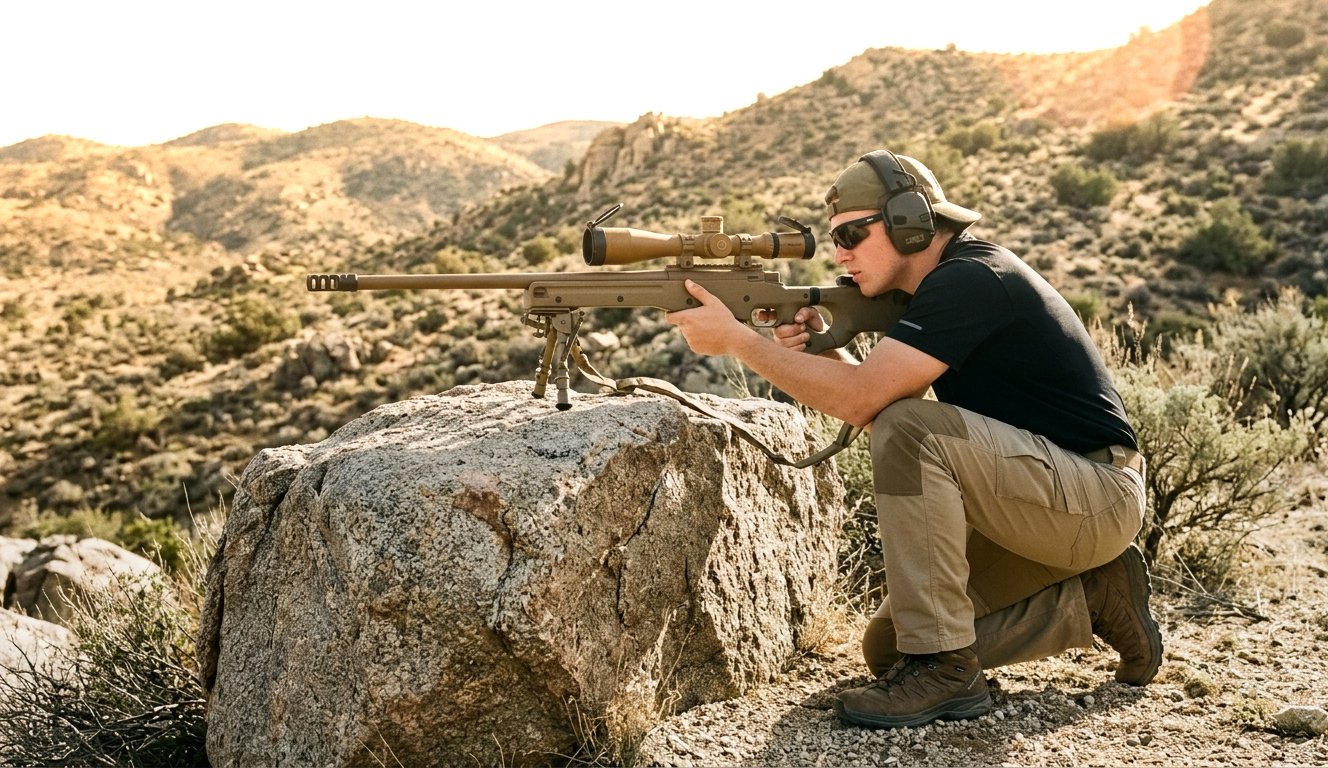
Welcome to the long game. Starting out in ELR feels like a wall of gear, jargon, and four-digit price tags, but the part that actually decides hits at distance is cheaper than you think. Extreme Long Range is a skills sport before it is a hardware sport. The shooter who reads wind, ranges a target cleanly, and trusts a dope card they built themselves will land more hits than a richer beginner every weekend. This guide walks you through the first year the way I'd coach a friend: which skills matter, why they matter, and how to build them without spending a fortune.
The single most useful idea I can give you up front is this. The cartridge is the cheapest variable in the whole equation, and the wind-reading brain is the most expensive. So we build the brain first, on the cheapest rifle that will teach it.
The three skills that actually matter
Almost everything in long-range shooting reduces to three skills. Ballistics is understanding how your bullet flies and how to predict where it lands. Handloading, or at least understanding ammunition consistency, is making the bullet leave the muzzle at the same speed every time. Wind reading is the call you make in the half-second before you break the shot, and it is the one that trips up everyone.
These three skills are caliber-independent. The math that puts a .223 on steel at 700 yards is the same math that puts a magnum on steel at 1,500. You do not need the magnum to learn the math. You need reps, a notebook, and a target you can afford to shoot at all day.
That ordering matters because of where misses come from. Bryan Litz of Applied Ballistics, using his Weapon Employment Zone analysis, makes the point bluntly: if you are missing the target for reasons unrelated to vertical dispersion, then reducing vertical dispersion will not improve your hit percentage much.1 Translated for a beginner, that means wind and position cause most of your misses, not five feet-per-second of velocity spread. So we spend our energy where the misses live.
Start small, cheap, and soft
The temptation when starting out in ELR is to buy the biggest cartridge you can flinch through. Resist that urge, because heavy recoil teaches a flinch before it teaches anything else. The smarter path is what we call Relative Long Range: take a small, inexpensive, low-recoil caliber and push it to its practical ceiling. You learn every long-range lesson at a fraction of the cost and none of the punishment.
The .223 Remington is the sweet spot for most new shooters. Fired from the same rifle, the .223 Remington has less than one-fifth the recoil of the .308 Winchester.2 Low recoil is not just about comfort. Soft recoil lets you stay in the scope and watch your own bullet hit, which is how you self-correct a wind call. It also keeps you from building a flinch, which quietly wrecks beginner accuracy. The .223 is cheap to feed, ammo is everywhere, and it makes a fine RLR project out to around 800 yards.
If you want to go even cheaper, the rimfire .22 LR is the ideal trainer. The rifle maker Sako puts it plainly: with rimfire rifles, wind reading, windage corrections, range-finding, and all other ballistic calculations must be done with equal process, and the only practical difference from a centerfire rifle is a shorter range.3 A .22 LR gets pushed hard by wind and slides toward transonic trouble by 200 to 300 yards, so it teaches wind reading at backyard distances with near-zero recoil and almost-free ammunition. More rounds per dollar means more reps on fundamentals.
When you are ready for a "real" precision cartridge without the punishment of a magnum, a soft-shooting 6mm is the logical next step. AccurateShooter notes that the lesser recoil of the 6BR works in the shooter's favor over a long string of fire.4 High-BC 6mm bullets cut through wind well, which is why they are the common choice in precision competition. But that is a later purchase. Start with the .223 or the .22 first.
Ballistics, plainly: muzzle velocity is the foundation
A ballistic prediction is only as good as the speed you feed it, and that speed has two jobs. First, you need to know your average muzzle velocity accurately so a solver can predict your drops. Second, you want the shot-to-shot variation in that velocity to be small so your groups stay tight at distance.
Why does velocity spread matter so much far away? Litz explains it cleanly: faster shots hit higher and slower shots hit lower, and the more spread there is between your fastest and slowest shots, the taller your groups get at long range.5 Up close you never notice the spread. At 100 yards a 30 fps swing barely moves the hole. Downrange it stacks into vertical stringing, which is why velocity spread fools so many new shooters who chronograph nothing and zero at 100.
And it shows up sooner than you would guess. Applied Ballistics warns that starting around 300 yards you can see significant errors in predicted drop if you do not model the bullet's muzzle velocity accurately.6 That single sentence is the reason a chronograph belongs near the top of your shopping list, ahead of a fancier scope or a second rifle.
It helps to know what "muzzle velocity" even is. SAAMI, the industry standards body, defines instrumental velocity as the velocity of a projectile recorded by suitable instrumentation located a predetermined distance from the muzzle.7 In other words, muzzle velocity is an instrument reading taken a known distance from the bore, not a magic number stamped on a box. Your job is to measure your own.
Reading your ammo: standard deviation and extreme spread
When you start measuring velocity, you will meet two numbers: extreme spread and standard deviation. Extreme spread is just the gap between your single fastest and single slowest shot. It ignores everything in between, which makes it a weak statistical indicator. Standard deviation, or SD, takes every shot into account, so it is the number that actually tells you how consistent your ammo is.
The two are related in a useful way. Litz notes that 95 percent of shots fall within plus or minus two standard deviations of the average. His worked example: an average of 3,000 fps with an SD of 10 fps means 95 percent of shots, that is 19 out of 20, land between 2,980 and 3,020 fps.8 That is also why chasing a low ES on three shots is mostly noise, since one fast or slow round can set the whole number.
So what is a good SD? A clean benchmark ladder, again from Litz, runs like this. Around 20 fps is relatively poor consistency, typical of mass-produced factory ammo. Around 15 fps is better than average for factory ammunition but still substandard for handloaders. And 10 fps or less is typically the goal of most handloaders.9 Single-digit SD is excellent and uncommon.
Now the nuance that marks a thoughtful shooter. It is easy to over-focus on SD, but the returns diminish fast. The same WEZ analysis shows steeply diminishing returns: going from 20 to 15 fps SD bought only a few percent of hit probability, and going from 10 fps down to 3 fps bought barely one percent. Wind, not vertical spread, causes most long-range misses.1 Chase a reasonable SD near 10 fps, then put your energy back on the wind.
One more wrinkle for later. Ballistic coefficient also varies shot to shot and adds vertical at long range. Litz quantifies it: an MV SD of 5 fps has a comparable effect on vertical dispersion as a 0.5 percent SD in BC, and MV variation bites at shorter range while BC variation matters mostly far out.10 You do not need to act on that in year one. For now it is enough to file that away for year two.
The chronograph: your ammo's report card
A chronograph measures muzzle velocity, and they all work on the same principle: timing how long the bullet takes to cross a known distance, then dividing distance by time to get feet per second. Older optical units time the bullet between two light gates. The newer units ELR shooters favor use Doppler radar and never touch the rifle or need screens set up downrange.
The LabRadar is one such unit. American Rifleman describes it as a self-contained device using continuous-wave Doppler radar and advanced digital signal processing, with no light screens, able to measure single projectiles from 65 to 3,900 fps at an accuracy of plus or minus 0.1 percent.11 Because radar tracks the bullet in flight, it can report velocity at several downrange distances and back-calculate the muzzle velocity, which also lets it estimate your real BC. That is a lot of information from one tool.
The Garmin Xero C1 Pro is the compact, beginner-friendly option that sits right next to the rifle. Per Garmin's own manual it is a time-measuring chronograph, accurate to plus or minus 0.1 percent of target velocity, using an algorithm that does not need position input to measure true muzzle velocity.12 Best of all, it reads out the exact stats you care about. Garmin's manual defines standard deviation right on the device as a number showing how much recorded velocities deviate from the average, where a low value means the velocities cluster close together.12 You read your SD and ES straight off the screen. That is your ammo's report card, printed for you after every string.
Handloading: a refinement, not step one
Here is where I'll save you some money and some grief. Handloading is real and worthwhile, but it is not your starting point.
The defensible case for rolling your own ammo is consistency. By controlling neck tension, charge weight, and case prep, you can tune a load to your barrel and chase a low SD that factory ammo rarely matches. The ammo maker Eagle Eye illustrates why that vertical control matters: for a .308 175-grain match bullet, the difference between 2,600 and 2,660 fps works out to 21.9 inches of vertical at 1,000 yards.13 Velocity swings become vertical misses, but only far enough out that the spread exceeds your other errors.
And that is exactly why handloading is not job one. A beginner's biggest error source is the wind call and the shooting position, not five fps of SD. Quality factory match ammunition with single-digit SD will carry you through your entire first year and most of your second. It spares you the load development time, bench equipment, and safety learning curve that careful reloading deserves.
My approach: start with premium factory match ammo. Buy the chronograph. Learn what your rifle and that ammo actually do. Then, once your fundamentals are solid and you understand your numbers, take up handloading specifically to lower SD and tailor a load to your barrel. Do not blame a 600-yard miss on your ammo. At that distance, blame the wind, because it is almost always the wind.
The ranging problem: distance is everything
You cannot dial a correct elevation without a correct distance, and drop scales fast far away, so a small ranging error becomes a big vertical miss. A laser range finder solves this. A ranging error of even a few yards turns into a real miss at long distance, which is why a quality rangefinder belongs early in your kit, not late. That is a center hit turned into a miss off the bottom of the plate.
A good rangefinder does more than measure distance. When you shoot uphill or downhill, the ballistic range your bullet actually experiences is shorter than the straight-line distance to the target, so a quality unit gives you the angle-corrected number automatically.
The Vortex Razor HD 4000 GB is a capable example. American Hunter reports it ringing steel out to 4,000 yards, with an onboard GeoBallistics solver, built-in environmental sensors for temperature, pressure, and humidity, and a Horizontal Component Distance mode that hands you the slope-corrected range.14 One beginner caution that applies to every rangefinder: real-world steel ranging falls well short of the advertised maximum, because those headline numbers assume big reflective boards in perfect light.
The solver: turning data into a firing solution
A ballistic solver takes your bullet data, the environment, and the distance, and computes the elevation and windage corrections to put your first shot on target. Its inputs are muzzle velocity, ballistic coefficient or a custom drag model, atmospheric data like pressure and temperature and humidity, and target data like range, angle, and wind. The output is your firing solution. The rule is simple: the more accurate the inputs, the more accurate the output.
The Kestrel 5700 Elite with Applied Ballistics is the field standard. Kestrel states it measures wind speed and direction, temperature, humidity, pressure, and altitude, then computes elevation and windage solutions for accuracy on extended long-range shots.15 It also applies the corrections that matter far out, and it can pull from the Litz library of custom bullet drag models for the most precise transonic and subsonic solutions available.16
That last detail is worth a beginner's attention. A G1 or G7 ballistic coefficient is a single-number approximation of how a bullet sheds speed compared to a standard reference projectile. A custom drag model is the bullet's own measured drag curve. As Applied Ballistics describes it, custom drag models are a more refined way of modeling drag because you use the actual measured drag of a specific bullet rather than referencing a standard like G1 or G7.17 The payoff comes when your bullet slows toward transonic, exactly where standard curves start to drift.
Make sure your scope can reach
Here is a failure mode that ambushes nearly every new long-range shooter: running out of elevation. Your scope has only a finite amount of internal adjustment, and once you have used part of it to zero, only some travel is left for dialing up. Long-range drops can demand more up-elevation than you have, and you will hit the mechanical stop unable to dial higher.
First, learn the two languages of correction. A minute of angle is one-sixtieth of a degree and subtends 1.047 inches at 100 yards, which for practical purposes is about an inch.18 A milliradian, or MIL, is the other dialect, where one mil equals 3.6 inches at 100 yards.19 Both grow linearly with distance, so 1 MOA is roughly 10.5 inches at 1,000 yards. Pick one system and live in it.
Now here is how to fix it. Warne Scope Mounts explains that when a shooter dials elevation for ranges longer than the zero distance, at some point they run out of elevation in the scope. A 20-MOA base is canted down in the front toward the barrel, and that downward cant is what allows more usable up-elevation in the scope.20 In plain terms, a canted base steals nothing and recovers roughly 20 MOA of up-travel, which is often the difference between reaching distance and bottoming out around 600 yards on a flat base. For our RLR thesis, insufficient scope elevation is one of the very real ceilings that caps how far a given rifle can reach. Check your travel before you blame your dope.
Build a dope card that reads to your rifle
Your dope card is the heart of the whole system. DOPE stands for Data On Previous Engagements, and the card simply lists the elevation correction you need at each distance. The catch is that it has to be true to your rifle, your ammo, and your conditions, not to a printout from an app.
Build it by shooting. First, establish a rock-solid 100-yard zero, where point of aim equals point of impact. Then shoot in 100-yard increments out to your maximum, recording the actual elevation that put rounds on target at 200, 300, 400, and onward. That record is your dope card. It belongs to your rifle and no one else's.
The reason you must verify by shooting is that a solver is only a model. Its output depends on inputs that are never perfectly known: true average velocity, true BC, sight height, zero range, and the atmosphere. Small input errors compound with distance, which is exactly why drop error becomes significant past 300 yards if your velocity is off. The fix is empirical. You shoot at distance, see the miss, and correct the math.
That correction has a name: truing. American Rifleman describes the standard workflow, where a shooter test-fires at several distances, a process called truing, to determine exactly how high or low the hit landed versus the computer's point of aim. The program then compares point of impact to point of aim and calculates the muzzle velocity that corresponds to that actual impact.21 The Kestrel does the same thing through its velocity calibration: Applied Ballistics notes that MV truing adjusts the solver's initial velocity to match the observed drop at a supersonic range.22 You let your real hits correct the numbers until prediction matches reality. Trust the math to get you close. Trust your hits to get you right.
Reading the wind: the skill that decides most hits
Wind is the highest-payoff skill you can build, because wind, not velocity spread, is what causes most long-range misses. The good news is that you can practice it cheaply, which is the entire point of starting on a .223 or a .22.
Start with the clock method. Picture a clock centered on you, with 12 o'clock straight downrange. Wind from 3 or 9 o'clock is a full-value crosswind, pushing the bullet sideways with all its force. Wind from 12 or 6 is essentially head or tail wind and barely deflects the bullet. Angles between are partial value. A wind from 1 or 2 o'clock might count as roughly half value.
Then learn to read mirage, the heat shimmer you see through a spotting scope. When the mirage boils straight up, the crosswind is near zero. As wind picks up, the shimmer lays over and flows sideways, and a hard flat run signals strong wind. Mirage gives you a free wind reading right in your optic.
For making actual calls, many shooters carry a one-mph constant: find how far a one-mph full-value wind moves your bullet at a given distance, then scale it by wind speed and clock value. The mechanics matter less than the habit. Watch the flags, the grass, the dust, and the mirage, make a call, then record the correction that actually worked. That wind dope, written down over many sessions, becomes your real edge.
Respect the transonic ceiling
Every cartridge has a practical ceiling, and for predictable hits it is usually the speed of sound. At 68 degrees Fahrenheit the speed of sound in air is about 1,125 fps, which is your Mach 1 yardstick.23 A bullet at 2,250 fps is flying at Mach 2.
Trouble begins when the bullet slows toward Mach 1. Applied Ballistics warns that going transonic is generally not good for bullets, because a bullet can lose stability entering the transonic zone and lose BC as a consequence, with effects starting around Mach 1.2 as the bullet drops below 1,340 fps.24 The mechanism, for spin-stabilized bullets, is that near the sound barrier the center of pressure moves forward and the overturning moment on the bullet grows, which is destabilizing.25
For a beginner the takeaway is direct. A cartridge's practical long-range ceiling is often the range where the bullet slows into transonic flight, groups open up, and drops turn unpredictable. Staying supersonic all the way to the target is the goal for repeatable hits, and it is exactly the limit the RLR game asks you to find. Push your .223 until its groups open up and its drops turn unpredictable, note where that happens, and you have learned the most important lesson the cartridge has to teach.
Find your people
The last piece is the one no chronograph can give you. Get involved in the shooting community, because it is far easier to learn alongside others than alone. A local precision or rimfire match is the fastest classroom in the sport. You will watch experienced shooters read conditions you cannot yet see, you will borrow gear before you buy it, and you will get useful feedback on your position.
Most ELR and PRS-style matches are welcoming to beginners, and many run a "no dumb questions" culture that genuinely means it. Bring your cheap rifle. Nobody serious will judge a .223 on the firing line, because everyone there knows the .223 shooter is learning the same wind that trips up the magnum shooter twenty feet away. Show up, shoot, ask questions, write everything down. That is how the first year is supposed to go.
FAQ
What is the best cartridge for someone starting out in ELR?
For a beginner, the .223 Remington is hard to beat as a first ELR-style cartridge. Fired from the same rifle it produces less than one-fifth the recoil of a .308 Winchester, so you can spot your own impacts and avoid building a flinch.2 It is cheap, common, and makes an excellent Relative Long Range project out to roughly 800 yards. A .22 LR is an even cheaper trainer that teaches the same wind-reading skills at shorter distances.3
Does a .223 Remington really teach the same skills as a magnum?
Yes, because the core long-range skills are caliber-independent. Sako notes that with a rimfire or small centerfire rifle, wind reading, windage corrections, range-finding, and all ballistic calculations must be done with equal process, and the only practical difference is shorter range.3 The math that lands a .223 at 700 yards is the same math that lands a magnum at 1,500, so you learn it cheaply first.
How low does my standard deviation need to be when starting out in ELR?
Aim for a velocity standard deviation around 10 fps and then stop worrying about it. Bryan Litz's benchmark puts roughly 20 fps as poor factory-ammo consistency, 15 fps as better than average, and 10 fps or less as the typical handloader's goal.9 Below that, returns diminish sharply, and wind causes far more of your misses than velocity spread does.1
Why does my ballistic solver get the drop wrong at long range?
A ballistic solver is a model, and its prediction is only as good as your inputs for velocity, BC, and atmosphere. Small errors compound with distance, which is why drop predictions go significantly off past 300 yards if muzzle velocity is inaccurate.6 The fix is truing: you shoot at distance and let the solver adjust its velocity to match your real impacts.21
Do I need to handload before getting into long-range shooting?
No. Handloading is a refinement you can add later, not a starting requirement. Quality factory match ammunition with single-digit SD will carry a new shooter through the first year or two with zero load-development time. Handloading's real benefit is tuning a low-SD load to your barrel, and that vertical control only matters far enough out that velocity spread exceeds your wind and position errors.13
Citations
- (2015). How Much Does SD Matter?. PrecisionRifleBlog.com (citing Bryan Litz).
- (2024). 223 vs 308: Which Is Better For You?. The Big Game Hunting Blog (John McAdams).
- (2023). Training with a 22 LR. Sako (manufacturer).
- (2023). .308 Win vs 6BR vs .223 Rem — Recoil Energy Comparison Chart. AccurateShooter.com Daily Bulletin.
- (2021). Measuring Muzzle Velocity (Chapter 15, Modern Advancements in Long Range Shooting). Applied Ballistics, LLC (Bryan Litz).
- (2021). Measuring Muzzle Velocity (Chapter 15). Applied Ballistics, LLC (Bryan Litz).
- Instrumental Velocity (Glossary). SAAMI.
- (2020). Shot-to-Shot Variation in Muzzle Velocity and Ballistic Coefficient. NRA Shooting Sports USA (Bryan Litz).
- How Much Does SD Matter?. PrecisionRifleBlog.
- (2020). Shot-to-Shot Variation in Muzzle Velocity and Ballistic Coefficient. NRA Shooting Sports USA (Bryan Litz).
- Review: LabRadar Chronograph. NRA American Rifleman.
- Xero C1 Pro Chronograph Owner's Manual. Garmin.
- (2021). Velocity Standard Deviation for Long Range Shooting. Eagle Eye Precision Ammunition (manufacturer).
- (2021). First Look: Vortex Razor HD 4000 GB Ballistics Rangefinder. American Hunter (Official Journal of the NRA).
- (2025). Kestrel 5700 Elite Wind & Weather Meter with Applied Ballistics. Kestrel Instruments (manufacturer).
- (2025). Kestrel 5700 Elite Wind & Weather Meter with Applied Ballistics. Kestrel Instruments (manufacturer).
- (2024). Applied Ballistics — Custom Drag Models and the solver. Applied Ballistics LLC (manufacturer).
- Rifleman Q&A: What Does 'MOA' Mean?. NRA American Rifleman.
- Mil, MOA or Inches?. NRA Shooting Illustrated.
- 20 MOA Explained. Warne Scope Mounts.
- Ballistic Software for Long-Range Shooting. NRA American Rifleman.
- (2024). Custom Drag Factor (CDF). Applied Ballistics LLC (manufacturer).
- Subsonic Ammo 101. American Rifleman.
- (2021). Transonic Effects on Bullet Stability & BC. Applied Ballistics, LLC (Bryan Litz), republished by AccurateShooter.com.
- Transonic Effects on Bullet Stability & BC. AccurateShooter.com (Bryan Litz, Applied Ballistics).