
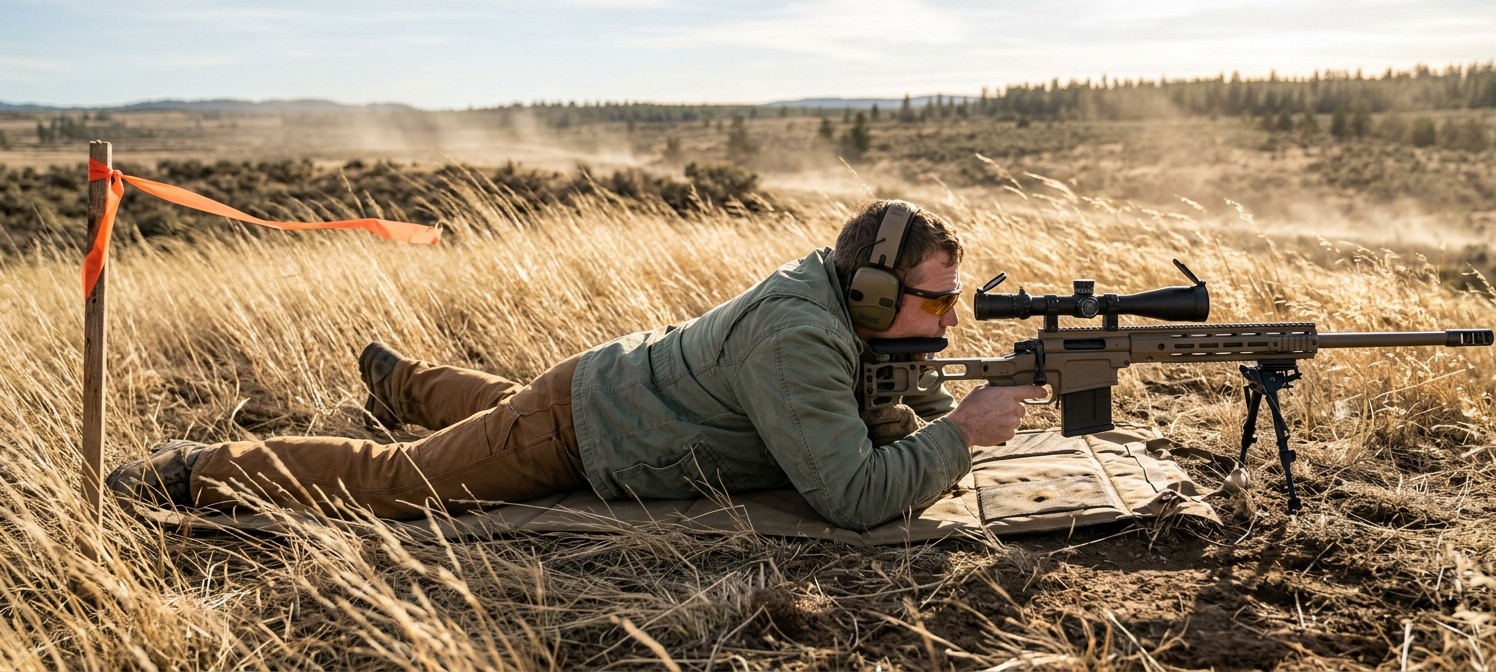
You can convert almost any wind into a usable hold without a calculator, a ballistic app, or a single line of trigonometry. The trick is a mental model that experienced shooters have leaned on for generations, and it reduces the whole problem of wind direction to a single multiplier. Picture a clock face laid flat over your shooting position, then read which hour the wind is coming from. That hour tells you how much of the wind actually matters, and the rest is arithmetic a grade-schooler could finish. This is the clock method for wind calls, and the goal of this guide is to make it second nature.
The method does not replace careful observation, and it will not invent information you did not gather. What it does is take the wind speed and direction you already read and translate them into a number you can hold for, quickly and under pressure. Once the logic clicks, you stop freezing over wind direction and start converting it on reflex.
What the clock method actually is
Imagine standing at the center of an enormous clock painted on the ground. The twelve sits downrange, straight out toward your target, and the six sits directly behind you. Three o'clock is off to your right, nine o'clock off to your left, and the remaining hours fill in around the circle at even spacing. Every direction the wind could possibly come from now has an hour attached to it, which gives you a shared language for describing the angle.1
The reason this overlay helps is that wind direction is really a question about angle, and angles are awkward to eyeball in raw degrees. Saying a wind comes from "about thirty degrees left of the target line" is clumsy and slow. Saying it comes from "eleven o'clock" is instant, because the clock is a shape your brain already knows cold. You are borrowing a familiar picture to pin down an unfamiliar measurement, which is exactly the kind of mental shortcut that survives the stress of a real shot.
Once the wind has an hour, the method assigns it a value, and that value is the heart of everything that follows. The value answers one essential question. How much of this wind is actually shoving my bullet sideways?
Why direction changes the push
Before the values make sense, it helps to understand why direction matters so much in the first place. A bullet in flight only drifts from the part of the wind that crosses its path at an angle. A wind blowing straight down the range from twelve o'clock, directly toward you or directly away, runs parallel to the bullet and exerts almost no sideways force on it. A wind blowing straight across from three or nine o'clock cuts the path at a right angle and applies its entire strength as sideways push.
Everything between those extremes is a blend, and the blend follows the geometry of the angle. As the wind swings from straight-on toward full crossing, the share of its strength that acts sideways grows smoothly, which is the same reason a sail catches more or less wind depending on how it is angled to the breeze. The clock method takes that smooth curve and simplifies it into a few buckets you can memorize, so you trade a little precision for a great deal of speed. For most field shooting that trade is a bargain, and the rest of this guide shows you when the simple version is enough and when to refine it.
This is also a crosswind problem at its core, because the crossing component is the part that produces lateral drift. The clock value is just a fast way to estimate how large that crossing component is for any given wind angle.
The three values that do the heavy lifting
The simplest version of the clock method uses three values, and for a huge share of practical shooting those three are all you ever need.
A full-value wind comes from three o'clock or nine o'clock, straight across your line of fire, and you count all of it.2 If your meter reads ten miles per hour from nine o'clock, you treat it as a ten mile per hour crosswind and hold accordingly. This is the worst case for drift, because none of the wind's strength is wasted blowing up or down the range.
A no-value wind comes from twelve o'clock or six o'clock, straight toward you or straight away, and you count none of it for horizontal hold. A headwind or tailwind still does subtle things to your trajectory, slightly steepening or flattening your drop, but it pushes the bullet neither left nor right, so it contributes nothing to your windage call. You read it, you note it, and you set it aside for the sideways problem.
A half-value wind covers the angled hours between those extremes, the one, two, four, five, seven, eight, ten, and eleven o'clock directions, and you count roughly half of it. A ten mile per hour wind from eight o'clock becomes about a five mile per hour crosswind for the purpose of your hold. Lumping all the angled hours into one half-value bucket is an approximation, and a later section sharpens it, but as a starting point it keeps you fast and close enough to hit.
Heads up. The clock describes where the wind comes from, not where it is going. A wind "from nine o'clock" is moving left to right across your view. Mixing up from and to flips your hold to the wrong side, which is a common early mistake worth drilling out deliberately.
The one multiplier that runs the whole system
Here is the move that makes the clock method feel like a magic trick. You assign each of those three values a multiplier, and you multiply your measured wind speed by it to get the effective crosswind. Full value is one, half value is one-half, and no value is zero. That single rule is the entire engine.
The number you get out, the effective crosswind, is the only wind figure you carry into your hold. A twelve mile per hour wind from a half-value hour becomes six. An eight mile per hour wind from a full-value hour stays eight. A fifteen mile per hour wind straight down the range becomes zero, and you hold nothing for it sideways. You have collapsed two pieces of information, speed and direction, into one clean number, and that compression is the whole point of the wind value idea.
What makes this practical is that you can do it in your head in the time it takes to settle behind the rifle. Halving a number is trivial, and multiplying by one or zero is no work at all. You are not solving for the sideways component with trigonometry, you are approximating it with arithmetic your brain can run while your eyes stay on the target. The speed is the feature, not a compromise.
Turning the effective wind into a hold
A multiplier gives you an effective crosswind in miles per hour, but you do not hold in miles per hour. You hold in mils or in minutes of angle, so the last step converts that effective wind into an actual aiming correction. The clock method hands the wind problem off to your existing dope at this point, and that handoff is what makes it usable.
Most shooters build their drop and wind data around a single reference wind, very often a ten mile per hour full-value crosswind, because round numbers scale easily. Your card might tell you that a ten mile per hour wind needs a certain hold at six hundred yards.3 Once the clock method gives you an effective crosswind, you simply scale that reference hold by the ratio of your effective wind to the reference. An effective wind of five miles per hour against a ten mile per hour card is half the hold. An effective wind of fifteen is one and a half times the hold.4
That scaling is the second piece of mental math, and it is as light as the first. You are halving, doubling, or adding a half again, all operations you can run without breaking your position. The clock method converts direction into a number, and your DOPE converts that number into a hold, and neither step asks more of you than grade-school arithmetic. This is also where a ballistic solver wins its place for those who carry one, since it will scale the reference wind for you, but the clock logic is what lets you sanity-check the machine or work without it.
Pro tip. Build your wind dope around a ten mile per hour full-value reference and memorize it cold. With that one column in your head, the clock method becomes a two-step reflex, find the multiplier, then scale the ten mile per hour hold. Everything else is the same loop at a different speed.
A worked example you can copy
Walk through a complete call so the steps lock together. You are set up on a target at six hundred yards, and your wind meter reads twelve miles per hour. You watch the grass and the mirage and judge the wind is coming from about ten o'clock, angling in from your front left.
The first step is the value. Ten o'clock is one of the angled hours, so it is a half-value wind, and your multiplier is one-half. Twelve miles per hour times one-half gives you an effective crosswind of six miles per hour. That single number now carries everything you need from the wind's speed and direction.
The second step is the hold. Suppose your card says a ten mile per hour full-value wind takes one mil of hold at six hundred yards. Your effective wind is six miles per hour, which is six-tenths of the reference, so your hold is six-tenths of a mil. You hold into the wind, on the upwind side, and you break the shot. The whole conversion, from raw reading to final hold, took two small multiplications and no tools.
Now change one thing to prove the system flexes. Keep the twelve mile per hour wind but move it to nine o'clock, straight across. The multiplier jumps to one, the effective crosswind becomes the full twelve, and your hold scales to one and two-tenths mils against that same ten mile per hour, one mil reference. Same wind speed, different clock hour, and the method handed you a different and correct hold without any fuss.
The more precise version when you want it
The three-value system is fast because it rounds, and rounding has a tradeoff you should understand rather than ignore. The angled hours are not all the same. A wind from one o'clock crosses your path at a shallower angle than a wind from two o'clock, so it actually pushes the bullet less, even though the simple method calls both of them half value.
The geometry behind the exact value is the sine of the wind's angle off the straight-down-range line, which sounds like math you wanted to avoid, but you never have to compute it on the clock. You just memorize a slightly finer set of buckets. The one, five, seven, and eleven o'clock hours sit close to half value, near one-half. The two, four, eight, and ten o'clock hours sit closer to nine-tenths of full value, so treating them as roughly three-quarters is more accurate than calling them half. The three and nine o'clock hours stay full, and twelve and six stay zero.2
Adopting the finer buckets has almost no downside in speed and gives real accuracy at distance, where a sloppy direction estimate turns into a visible miss. I prefer to teach the three-value version first, let it become automatic, and then layer the four-bucket refinement on top once the basic reflex is solid. That order matters, because a method you can run under stress beats a more exact one you fumble.
What the clock method does not tell you
The clock method solves one specific piece of the wind problem, the conversion of a single wind reading into a hold, and it is worth being clear about the pieces it leaves untouched. Knowing its limits is what keeps you from trusting it past where it is worth trust.
It does not tell you the wind speed. You still have to read that from a meter, the grass, the wind flags, or the boil of the mirage,5 and a wrong speed feeds a wrong hold no matter how clean your multiplier is. The clock handles direction, and your eyes and instruments handle speed, and the call is only as good as both inputs together.
It also assumes one wind along the whole flight, when real wind shifts between the muzzle and the target. The air near you can blow from a different hour than the air downrange, and a single clock reading cannot capture that spread.6 Good wind reading builds a picture across the course and weights the segments, while the clock method gives you a clean way to value any one of those segments once you have read it.
Finally, the clock value covers only the wind. Lateral effects that are not wind, such as spin drift from the bullet's own rotation, ride alongside your wind hold but come from your solver or your dope, not from the clock.7 A complete call layers them in separately, so do not expect the multiplier to account for them.
Caution. A confident clock value built on a careless speed read or a single-point wind guess is still a miss waiting to happen. The method makes the easy part fast. It does not make the hard part, judging the actual wind, go away, so keep your attention on the reading itself.
When the simple version is enough
Most practical field shooting lives comfortably inside the three-value method, and it is worth saying so plainly, because precision-minded shooters sometimes over-build a process that did not need it. Inside a few hundred yards, on a reasonably sized target, the gap between a half-value estimate and a finely computed sine value is smaller than your other errors. Your speed read, your position wobble, and the natural shift of the wind all dwarf the rounding in the multiplier.
The finer buckets and the solver start to matter as range stretches and the target shrinks, because every approximation you stacked grows with distance. A wind bracket, the realistic range from your lowest likely wind to your highest, is often a more useful tool at that point than a falsely precise single number. The clock method still feeds that bracket, since you run it for the low end and the high end and hold somewhere between.
The skill, then, is matching the tool to the shot. Run the fast three-value version when the shot is close and forgiving, reach for the four-bucket refinement and your solver when the distance and the target demand it, and let the wind hold vs wind dial decision follow from how steady the condition is. The method scales with you instead of locking you into one rigid routine.
How I would drill it
If I were building this reflex from scratch, I would start away from the rifle entirely, because the clock logic is pure mental reps. I prefer to call values on the wind I feel on a walk, naming the hour and the multiplier out loud for whatever breeze is moving the trees, until the value attaches itself to the direction automatically. That habit has no downside and builds the exact pathway you need under the gun.
My approach on the range is to pre-build the wind column before the first shot, memorize the ten mile per hour full-value hold for each distance I expect, and then practice only the conversion.8 I would read a wind, call the hour, halve or hold the number, scale the reference, and check it against my solver, treating the solver as an answer key rather than a crutch. Over enough reps the two multiplications fuse into one motion, and the wind stops being the part of the shot that rattles you.
When the wind genuinely confuses me, fishtailing across the line or switching hour to hour, I would stop forcing a single clock value and bracket it instead, running the method for the plausible extremes. That keeps me grounded in what I actually know, and it turns an impossible single call into a manageable range. The clock method is most valuable not when the wind is obvious, but when it is messy and you still need a number you can defend.
FAQ
What is the clock method for wind calls?
The clock method for wind calls is a mental system that converts wind direction into a single multiplier so you can quickly estimate a hold. You imagine a clock face over your position with twelve o'clock downrange, read which hour the wind comes from, and assign it a value of full, half, or zero. Multiplying your measured wind speed by that value gives the effective crosswind you actually hold for.
What does full value and half value mean in the clock method?
Full value means the wind crosses your line of fire at a right angle, from three or nine o'clock, so you count its entire speed toward your hold. Half value means the wind angles in from one of the in-between hours, so you count roughly half its speed. A no-value wind comes from twelve or six o'clock, straight up or down the range, and you count none of it for your sideways correction.
How accurate is the clock method for long-range shooting?
The three-value clock method is accurate enough for most field shooting inside a few hundred yards, where other errors outweigh its rounding. At longer range and on smaller targets, the angled hours benefit from a finer estimate, treating the two, four, eight, and ten o'clock directions as closer to three-quarters value rather than half. For demanding shots, shooters pair the clock value with a ballistic solver and a wind bracket to manage the remaining uncertainty.
Does the clock method account for wind that changes downrange?
The clock method does not account for wind that changes along the bullet's path, since it values one reading at a time. Real wind often blows from a different direction near the target than it does at the muzzle, so a single clock value cannot capture that spread. The practical fix is to read the wind at several points, value each segment with the clock, and weight the conditions nearest you most heavily.
Citations
- (2023). How to Read Wind for Long Range Shooting: Complete Guide. WOOX.
- (2023). How to Read the Wind: Intro to Precision Rifle Shooting. Precision Shooting.
- (2021). Understanding the Short Wind Table Shortcut for Wind. Long Range Shooting (TeachMe Interactive).
- (2022). Wind Calls: What is Your Gun Speed?. 360 Precision.
- John Antanies. (2016). How to Read Mirage to Estimate Wind Speed. American Hunter (NRA).
- (2023). Mastering the Art of Wind Reading for Long-Range Precision. Savage Arms.
- (2021). Lapua Ballistics Tips: Spin Drift Adjustment. Lapua.
- (2022). Gun Number: A Guide to Easier Wind Holds at Distance. Sun and Shadow Tactical.