
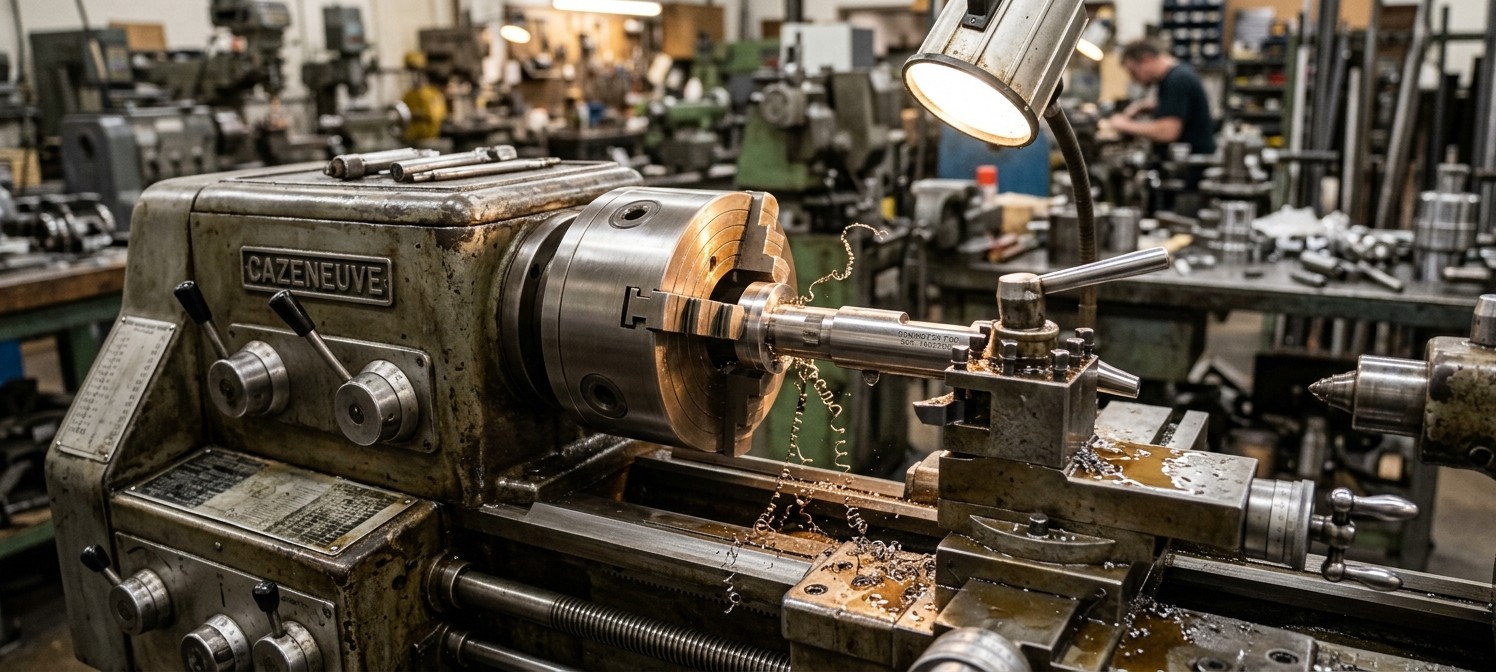
A factory Remington 700 leaves the line with its critical surfaces a few thousandths out of square, none of it a defect, all of it the normal slop of building rifles to a price. Action truing, also called blueprinting, is the gunsmithing work that cuts those surfaces back to a true geometric ideal so the barrel, bolt, and cartridge all sit square to the bore. Done well, it makes a factory receiver behave like a custom one, and it costs far less than buying new. This is a guide to what gets squared, what that actually corrects, and when truing is worth it over simply buying a custom action.
What truing and blueprinting mean
Blueprinting, also called truing, is the process of taking a factory action and re-machining its critical aligning surfaces so they sit square to the action's centerline. The goal is plain to state: every surface that locks together should be perpendicular and concentric to the bore, so nothing downstream inherits a built-in error.1
The reason it is needed is mass production. A receiver built to a price has small tolerances stacked in random directions, so the face may be slightly off square, the threads a touch eccentric, the lug seats not quite even. Each error is invisible and harmless on its own, but together they let the barrel and cartridge sit a hair off the bore axis, which degrades consistency before the first shot.
So truing is not adding anything exotic. It is removing the random slop, bringing one mass-produced action up to the geometric standard a custom maker builds in from the start. The same word, blueprinting, captures the idea, since the smith is cutting the part back to its ideal drawing.
Squaring the receiver face and threads
The first surfaces a smith addresses are the receiver face and the barrel threads. The receiver face is the flat ring the barrel shoulder clamps against, and it should be dead square to the bore with near-zero runout when indicated. If it is off, the barrel threads on slightly cocked, which tips the chamber off the bore axis.
The threads inside the receiver are cut next, single-point on a lathe so they run concentric to the action's true centerline. Factory threads are often a little eccentric, and truing them ensures the barrel screws in dead concentric rather than pulled to one side. Together, a squared face and concentric threads mean the barrel sits perfectly aligned when it is torqued home.2
This matters because the barrel is the part doing the shooting, and everything it does depends on starting square to the bolt and the case. A barrel mounted on a trued receiver begins its job aligned, which removes a source of inconsistency that no amount of barrel quality could fix on its own.
Squaring the bolt: face and lugs
The bolt gets the same treatment from the other direction. The bolt face, the recessed surface the case head seats against, is trued so the cartridge sits square to the bore rather than tipped a few thousandths. A square bolt face supports the case head evenly, which steadies ignition and case behavior.
The locking lugs are the other key surface. On a factory bolt the two lugs rarely contact their seats equally, so one lug may carry most of the firing load while the other barely touches. Lug lapping uses a fine abrasive and a lapping tool to cut the high spots until both lugs bear evenly, which keeps the bolt from cocking slightly under pressure and letting the case head shift.3
Because lapping removes a little metal and moves the bolt face rearward, the smith rechecks headspace afterward and sets it back within safe limits, often by setting the barrel shoulder during chambering. That is why truing and a fresh barrel chambering usually go together, since the chambering step is where final headspace is dialed in on the freshly squared action.
What truing actually corrects
It helps to be precise about what these cuts fix, because truing is sometimes oversold. What it removes is geometric error: a cocked barrel, a tipped cartridge, an unevenly loaded bolt, all the small misalignments that let parts sit slightly off the bore axis. Removing them gives the rifle a square, repeatable foundation to shoot from.
The payoff shows up as consistency. A cartridge that sits square to the bore, fired from a bolt that locks up evenly, behaves the same way shot after shot, and that repeatability is what tightens groups over a string. Truing is a core step when a smith sets out to accurize a rifle, alongside bedding the action, free-floating the barrel, and fitting a good trigger.
The size of the gain here is modest but meaningful. Truing removes the factory slop that genuinely costs precision, and on a rifle that is otherwise well built, that can be what separates a rifle that shoots to its barrel's potential from one held back by its own assembly. It is one of the small things, stacked with the others, that long-range precision is built from.
What truing does not fix
Just as important is what truing cannot do, because that is where people waste money. Truing squares the action, but it does not turn a mediocre barrel into a match barrel, fix a bad trigger, or overcome a sloppy bedding job. If the barrel is the weak link, no amount of receiver truing will reach the accuracy a better barrel would.
It also reaches a point of diminishing returns. Once an action is squared and wearing a quality barrel, further work on the receiver adds little, because the geometric errors are already gone. The next gains come from the barrel, the load, the optic, and the shooter, not from chasing the last fraction of a thousandth on a surface that is already true.
So truing is a foundation step, not a magic one. It removes a real source of error and lets the rest of the build perform, but it works only as part of a sound rifle. Truing a receiver and bolting a bargain barrel onto it spends money in the wrong order.
When it earns its cost over a new action
The real decision is truing a factory action versus buying a custom one, and it comes down to math and goals. Blueprinting a Remington 700 receiver, including the work, can run a few hundred dollars, while a custom action costs well over a thousand.4 For a shooter who already owns a sound factory rifle, truing the existing action and spending the difference on a barrel and glass is often the smarter path.
Truing wins when you have a factory action in hand, you are rebarreling anyway, and you shoot at a level where the squared foundation is enough. A blueprinted Remington 700 with a quality barrel will hold accuracy that most shooters' wind reading and positions will not outrun, which is why it remains a classic, cost-effective build.
A custom action wins when you are starting from scratch, want lot-to-lot consistency across several rifles, or are chasing the very top of a discipline, since custom actions have largely replaced trued factory receivers at the high end of competition.5 The break-even point is whether you already own the action and how hard you are pushing, so weigh the cost of truing against the cost of new, then put the savings where they shoot best, into the barrel and the optic.
What I'd do
If I already owned a sound factory action and wanted more from it, I'd have it trued at the same time as a fresh barrel chambering, since the chambering is where headspace gets reset on the squared action anyway. My approach is to pay for the squaring once, bolt on a quality barrel, and spend the saved money on glass rather than on a new receiver I do not need.
If I were starting a build from nothing, I prefer to buy a custom action rather than a donor plus truing labor, because by the time you add a factory receiver and the blueprinting bill, a custom action is often close in price and saves a step. I'd reserve truing for the rifle I already have, not the one I am building fresh.
Either way I'd keep the order of spending straight. The action, trued or custom, is the foundation, but the barrel and the optic are where most of the accuracy and most of the budget belong, so I would not pour money into a receiver while skimping on the parts that do the shooting.
FAQ
What is action truing and blueprinting?
Action truing, also called blueprinting, is machining a factory action's critical surfaces square to the bore. A gunsmith faces the receiver square, single-point cuts the threads concentric, trues the bolt face, and laps the locking lugs so they bear evenly. The result is a factory action with its random tolerances removed, so the barrel and cartridge sit aligned to the bore.
What does truing a Remington 700 actually fix?
Truing a Remington 700 fixes geometric errors left by mass production: a receiver face that is slightly off square, eccentric threads, a tipped bolt face, and lugs that contact unevenly. Correcting them lets the barrel thread on square and the cartridge sit aligned, which improves shot-to-shot consistency. It does not fix a poor barrel, trigger, or bedding.
Is blueprinting a factory action worth it over a custom action?
Blueprinting is usually worth it when you already own a sound factory action and are rebarreling, since it costs a few hundred dollars against a thousand or more for a custom action. A trued Remington 700 with a quality barrel shoots well beyond most shooters' limits. A custom action makes more sense when building from scratch or chasing the top of competition.
Does action truing require rebarreling?
Action truing usually goes together with rebarreling because lapping the lugs and squaring the bolt face move the bolt face rearward, which changes headspace. The new barrel's chambering is where the smith resets headspace to safe limits on the freshly squared action, so truing is typically done as part of fitting a fresh barrel rather than on its own.
Citations
- RifleShooter.com. (2014). Blueprinting (Truing) a Remington 700 Action. RifleShooter.com.
- Deep South Tactical. (2021). Truing the Remington 700 Action for Enhanced Accuracy. Deep South Tactical.
- Concealed AZ. (2022). Blueprinting and Truing Remington 700 Action: Expert Methods. Concealed AZ.
- Long Range Hunting Forum. (2021). Blueprinted 700 vs Custom Action. Long Range Hunting Forum.
- Cal Zant. (2024). Best Custom Rifle Action: What The Pros Use. PrecisionRifleBlog.com.