
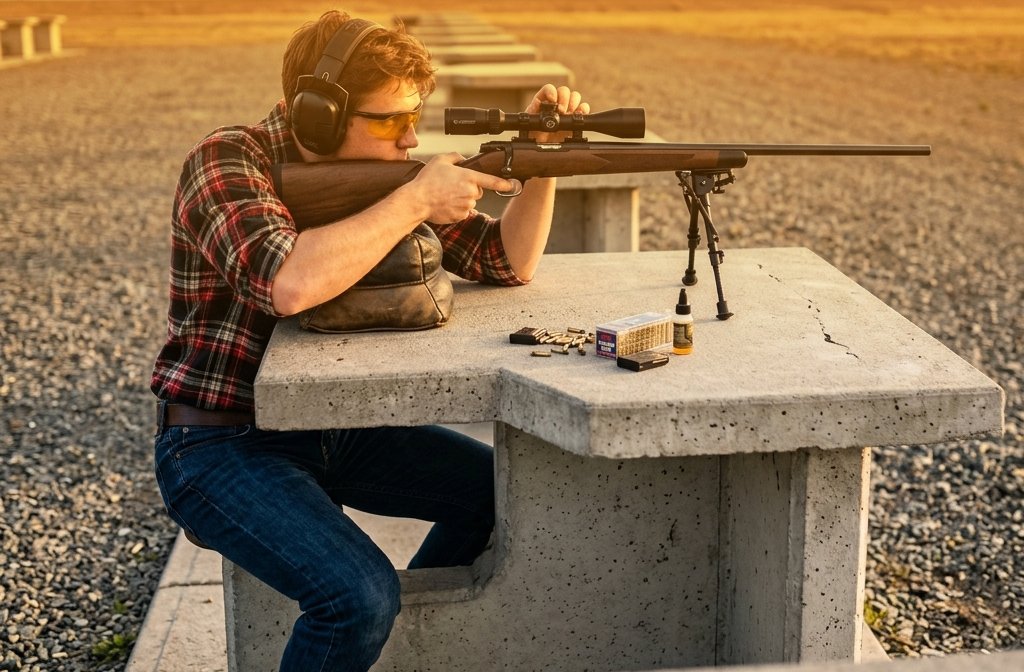
Why .22LR Barrel Twist Matters Past 200 Yards
The .22 Long Rifle is not an extreme long range cartridge by conventional standards. But under the Relative Long Range framework, taking a rimfire past 200 yards is exactly the kind of challenge that sharpens wind-reading skills and forces you to account for every variable. Barrel twist, groove count, rifling profile, and length all directly affect velocity consistency and trajectory predictability at distance.
The .22LR barrel twist rate is almost universally 1:16 inches. That standard has held since the cartridge's commercial introduction in 1887. The 40-grain lead round nose that defined early .22LR needed stabilization, and 1:16 delivered it across the velocity range rimfire shooters encountered. Modern match-grade .22LR ammunition still uses 40-grain bullets in most cases, and the 1:16 twist remains the industry norm.
But twist rate is only one variable. Groove count, rifling geometry, and barrel length interact with ammunition choice in ways that become visible only when you shoot beyond 100 yards.
The History of .22LR and Why 1:16 Became Standard
The .22 Long Rifle cartridge emerged from the J. Stevens Arms & Tool Company in 1887.1 It combined the .22 Long case with a 40-grain bullet, creating a round that balanced velocity, accuracy, and low recoil. Early rimfire barrels used 1:16 twist because the lead projectiles of the era required moderate rotational stability without excessive spin that could strip the soft bullet or cause leading.
Rifling twist rates are determined by bullet length, not weight.2 A longer projectile requires faster spin to remain stable in flight. The 40-grain .22LR bullet is short relative to its diameter, so a slower twist works. The 1:16 standard stabilizes bullets from 36 grains to 45 grains across the subsonic and supersonic velocity bands without issue.
Manufacturers experimented with faster twists in the mid-20th century, particularly for match rifles. Some European target barrels used 1:15 or even 1:14 twists to stabilize heavier 42-grain loads. But the performance delta was marginal, and the 1:16 twist remained dominant because it worked across the widest range of ammunition types.
The cartridge itself has not fundamentally changed since 1887. Modern match ammunition uses better powders, tighter tolerances, and higher-quality brass, but the bullet is still a 40-grain lead projectile at roughly 1,050 to 1,250 feet per second depending on barrel length and load. That consistency is why the 1:16 twist endures.
6-Groove Rifling: The Traditional Standard
Most .22LR barrels are cut with six grooves. The groove count affects how the rifling engages the bullet, how much surface area contacts the bore, and how quickly fouling accumulates.
Six grooves provide balanced engraving force on the bullet. When the bullet enters the rifling, the lands bite into the soft lead and impart spin. Six lands distribute that force evenly around the circumference, reducing the risk of deformation. Fewer grooves mean each land must do more work, which can distort the bullet if the lead is soft or the velocity is high.
Six-groove barrels are easier to manufacture with traditional button-rifling or cut-rifling methods. The tooling is standardized, and the process is well understood. That manufacturing simplicity keeps costs down, which matters in a rimfire market where barrels are often replaced due to fouling rather than erosion.
Fouling in .22LR barrels is lead and wax buildup from the bullet lubricant. Six grooves create more surface area for fouling to accumulate compared to polygonal designs, but they also make cleaning easier. A tight-fitting brush can reach into each groove and remove buildup mechanically.
Polygonal Rifling: Lower Friction, Less Fouling
Polygonal rifling replaces sharp lands and grooves with a smooth, undulating bore profile. The cross-section looks like a rounded polygon rather than a traditional star pattern. This design reduces the surface area in contact with the bullet, which lowers friction and can improve velocity slightly.
Polygonal rifling reduces fouling accumulation in .22LR barrels. The smooth bore profile gives lead and wax fewer places to cling. I've found polygonal barrels stay cleaner longer when shooting 200+ rounds in a session. Precision degrades less as fouling builds compared to six-groove barrels.
The velocity gain from polygonal rifling is real but small. Independent testing shows 10 to 30 fps increases compared to six-groove barrels of identical length, all else equal. That difference is measurable on a chronograph but unlikely to change your hit probability at 200 yards unless you're already running at the edge of transonic instability.
Polygonal rifling also imparts slightly less rotational energy to the bullet because the engagement is gentler. For .22LR, where bullets are already stabilized with a 1:16 twist, this is not a problem. The reduced engraving force can improve extreme spread and standard deviation because the bullet experiences less deformation during the launch phase.
The downside is cost. Polygonal barrels require different tooling and are more expensive to produce. Most factory rimfire rifles use six-groove barrels because the performance delta does not justify the price increase for casual shooters.
Barrel Length and Velocity: The .22LR Paradox
Conventional wisdom says longer barrels produce higher velocities. For centerfire cartridges, this holds true across a wide range of barrel lengths. But .22LR behaves differently.
Longer .22LR barrels can slow the bullet. Once the powder charge is fully burned, the bullet is no longer accelerating. If the barrel is long enough, friction between the bullet and the bore begins to decelerate the projectile. The crossover point depends on the ammunition, but it typically occurs between 18 and 24 inches for standard-velocity loads.
Match-grade .22LR ammunition is optimized for 22- to 26-inch barrels, which are common in benchrest and F-Class rimfire rifles. High-velocity .22LR loads may peak earlier, around 16 to 18 inches, because the faster-burning powder generates peak pressure sooner.
The velocity loss in longer barrels is not large. Testing with CCI Standard Velocity shows a 10 to 15 fps drop when moving from a 20-inch barrel to a 26-inch barrel. But that loss is consistent, which means it does not increase standard deviation. In fact, longer barrels often produce lower ES and SD because the bullet spends more time stabilizing before exit.
Longer barrels reduce standard deviation even when velocity drops. This is the paradox that makes long-barreled .22LR rifles viable for precision work past 200 yards. The extended dwell time allows pressure to equalize more fully, and the bullet exits with less variation in muzzle velocity. A 26-inch barrel shooting CCI Standard Velocity at 1,050 fps with an SD of 6 fps is more predictable at distance than an 18-inch barrel shooting the same load at 1,070 fps with an SD of 12 fps.
The trade-off is weight and handling. A 26-inch bull barrel on a rimfire rifle is heavy and awkward for field use. But if you're shooting from a bench or prone with a bipod, the added weight dampens movement.
Barrel Length and Practical ELR Performance
Taking .22LR past 200 yards requires managing two problems: transonic instability and wind drift. Barrel length affects both.
Most .22LR ammunition is subsonic or just barely supersonic at the muzzle. Standard-velocity loads leave the barrel at 1,050 to 1,080 fps. High-velocity loads run 1,200 to 1,280 fps. The speed of sound at sea level and 59°F is roughly 1,116 fps,3 so high-velocity .22LR crosses into transonic flight almost immediately.
Transonic instability occurs when the bullet slows through Mach 1. The shock wave shifts, and the bullet can tumble or yaw unpredictably. This is why subsonic .22LR is often more accurate at distance than high-velocity loads. The subsonic round never crosses the transonic band, so it flies predictably from muzzle to target.
A longer barrel shooting subsonic ammunition maintains velocity slightly better because the bullet exits with less turbulence. The extended dwell time allows the powder gases to push the bullet more smoothly, which reduces the variation in exit velocity that contributes to trajectory spread downrange.
Wind drift at 200 yards is the bigger problem. A 40-grain .22LR bullet has a ballistic coefficient around 0.140 G1, which is abysmal compared to centerfire match bullets. A 10 mph crosswind will push the bullet roughly 24 inches at 200 yards. Lower SD from a longer barrel does not change the BC, but it does tighten the vertical spread, which makes reading wind easier because you're not sorting wind drift from velocity variation.
Choosing Barrel Specs for .22LR Beyond 200 Yards
If you're building or buying a .22LR rifle for precision work past 200 yards, prioritize consistency over velocity.
A 22- to 26-inch barrel with a 1:16 twist is the baseline. This length stabilizes subsonic match ammunition and produces low ES and SD. The velocity loss compared to shorter barrels is negligible, and the consistency gain is measurable.
Polygonal rifling is worth the cost if you shoot high volumes. The reduced fouling and slightly lower SD make it easier to maintain zero across long strings. If you're shooting 50 rounds per session and cleaning afterward, six-groove rifling is fine.
Heavy contours reduce barrel whip. A bull barrel or heavy varmint profile stiffens the barrel, which reduces harmonic movement during the shot. This matters more for .22LR than for centerfire cartridges because the bullet spends more time in the bore, and any flexing affects exit timing.
Match the ammunition to the barrel. Subsonic match-grade loads like Eley Tenex, Lapua Center-X, or SK Rifle Match are purpose-built for long barrels and precision shooting. High-velocity bulk ammunition is optimized for short barrels and hunting, and it will not perform well at distance no matter how good the barrel is.
FAQ
Why is .22LR twist rate always 1:16?
The 1:16 twist stabilizes the 40-grain bullets used in .22LR across the full velocity range from subsonic to high-velocity loads. Faster twists offer no meaningful accuracy improvement, and slower twists risk instability with longer match bullets.
Does polygonal rifling really reduce fouling in .22LR?
Yes. The smooth bore profile gives lead and wax fewer surfaces to cling to, so fouling builds more slowly. You might run 300+ round sessions with polygonal barrels and clean half as often as with six-groove barrels of similar quality.
Why do longer .22LR barrels sometimes produce lower velocities?
Once the powder is fully burned, friction between the bullet and bore begins to slow the projectile. For most .22LR loads, this crossover occurs between 18 and 24 inches. The velocity loss is small, but it is consistent and does not increase standard deviation.
What barrel length is best for .22LR at 200 yards?
A 22- to 26-inch barrel produces the lowest standard deviation with subsonic match ammunition. The extended dwell time stabilizes the bullet and reduces velocity variation, which tightens vertical spread at distance.
The .22 Long Rifle cartridge emerged from the J. Stevens Arms & Tool Company in 1887.4
Most .22LR ammunition is subsonic or just barely supersonic at the muzzle.5
Citations
- (2024). 22 Long Rifle History: From Plinking to Precision. Savage Arms.
- Andrew Budd. Greenhill Formula for Optimal Rifling Twist Rate. vCalc.
- (2018). on target shooter nz: Stevens Arms Invented The .22 Long Rifle Cartridge. on target shooter nz.
- (2020). The .22 LR: History & Performance. American Rifleman.
- (2018). Top 6 Subsonic .22 LR Loads for Small-Game Hunting. American Hunter.