
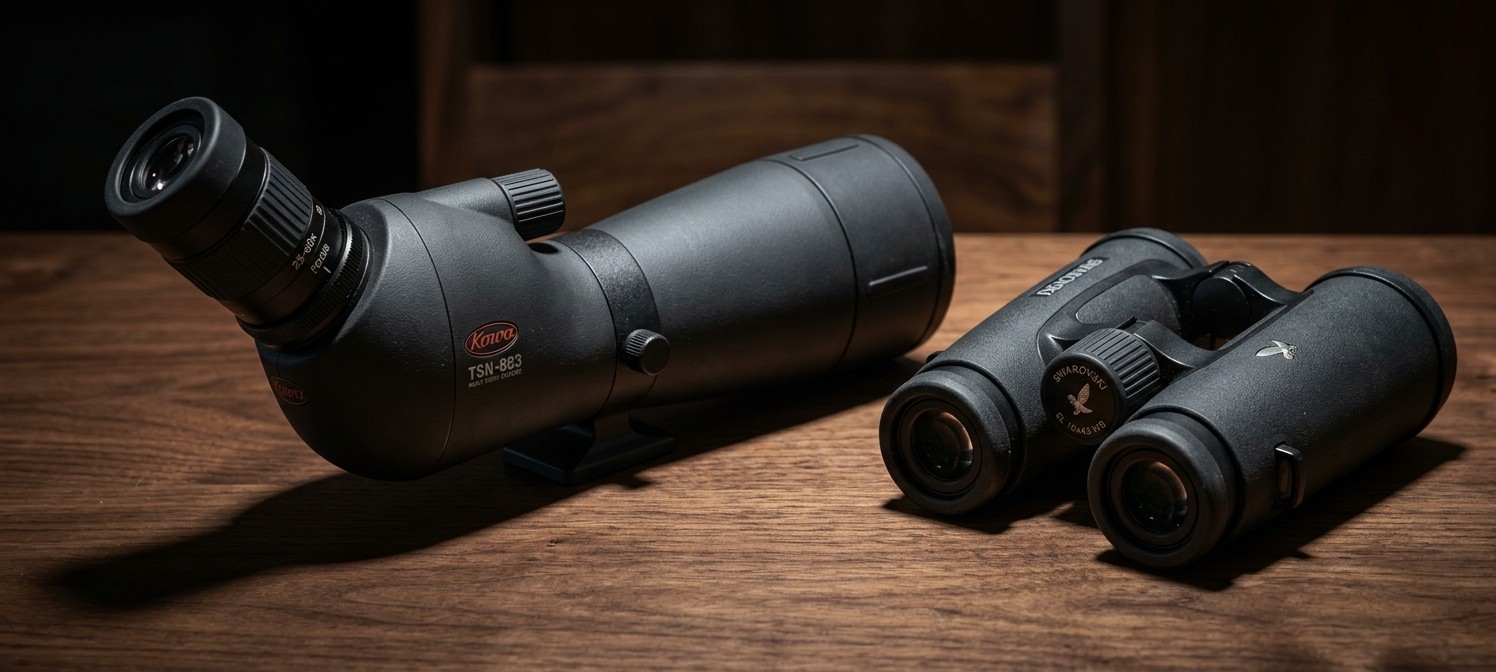
The hardest part of a long shot is the wind, and the best wind meter on the line is not a Kestrel, it is the shimmer of mirage and the streak of trace you can already see through your glass. The question is which optic shows them best, a high-power spotting scope or a pair of binoculars. Each has a real job, and for reading the air the answer is not the same as for finding a target. This is a guide to how a spotting scope and binoculars compare for calling your own wind, and why the mirage boiling off the ground is the cheapest wind meter you will ever own.
What each optic is for
A spotting scope is a high-magnification telescope, often 15 to 60 power, built to study a small patch of distance in detail.1 A shooter uses one between strings to confirm where the bullet landed, read the mirage downrange, and call corrections. Its power is what makes fine, faraway detail visible. It is a specialist tool for seeing far, usually run from a tripod because the magnification is too high to hold steady by hand.
A binocular feeds both eyes at once, usually at a gentler 8 to 12 power, which gives a wide, comfortable, immersive view you can hold without a tripod. Using both eyes reduces fatigue over long sessions and helps you pick movement and shape out of clutter, so the binocular is the first tool for scanning terrain and finding things. It trades the spotting scope's reach for a broad field and easy handling.
So the two are not really rivals across the board, they are tools for different stages. The binocular finds and orients, the spotting scope studies and confirms, and for reading the wind the choice depends on which wind cue you are after.
Mirage is the cheapest wind meter you own
Before comparing the glass, it is worth naming why either one matters so much for wind. Mirage, the shimmering distortion you see over warm ground through magnified optics, is not just heat haze in the way, it carries the wind. The direction it runs tells you which way the air is moving, and the angle it lays over tells you how fast, so the boil halfway to the target is a live readout of the wind where the bullet flies.
That makes mirage the cheapest wind meter you already own, because reading it takes no effort once you have a magnified optic pointed downrange. A handheld meter reads only the wind at your hand. Mirage shows you the air out where it actually bends the bullet, and it updates as conditions shift. The shooter who learns to read it has a wind sensor at every distance the glass can resolve.
The classic rule is to read mirage at half-distance rather than at the target, because the midpoint is where the bullet is most exposed to the wind.2 So the real value of a spotting scope or binocular, for wind, is that it lets you see that boil clearly enough to judge speed and direction, which is the whole game at long range.
Reading mirage: which optic wins
For reading mirage, the spotting scope usually has the edge, because magnification is what resolves the boil into a readable pattern.3 At 20 to 25 power a spotting scope shows the shimmer's angle and speed clearly at distance, and you can focus short of the target to read the mirage at half-distance precisely, which is exactly the technique the wind read depends on.4 The high power that makes a spotting scope tiring to hold is the same power that makes mirage easy to read.
Binoculars can read mirage too, especially the higher-power 12 to 15 power models, and their easy handling means you can pick up the boil quickly without setting up a tripod. But at typical binocular magnification the mirage is fainter and harder to resolve at long distance, so the read is rougher than a spotting scope gives. For a quick, near read, binoculars are fine; for a precise mirage call at distance, the spotting scope wins.
So if calling wind from mirage is your priority, lean toward the spotting scope and its power. The binocular still reads mirage usefully at moderate range, but the spotting scope is the better mirage instrument, which is why it is standard on the long-range line.
Reading trace: the spotting scope's edge
The spotting scope's other wind advantage is trace, the faint streak of disturbed air a bullet leaves in flight. Watching where that line curves against the background lets an experienced spotter read the wind in real time and see exactly where the shot went. The trace is the bullet's actual path bending in the air. It is one of the most useful tells a spotter has.
Trace is a spotting-scope phenomenon in practice, because seeing it takes magnification, a steady tripod-mounted view, and the right light. It reads best against a uniform dark background in low-angle sunlight with crisp air, and heavy heat shimmer can wash it out. Binoculars rarely deliver the steady, magnified view that makes trace readable, so this cue belongs to the spotting scope.
So between mirage and trace, the spotting scope reads both better, which is why a serious shooter calling their own wind reaches for one. The binocular is the scanning and finding tool; the spotting scope is the wind-and-impact instrument once the shot is on.
When binoculars are enough
None of that means a spotting scope is always the right buy, because the binocular wins on portability and speed, and for many shooters that matters more. A hunter covering ground, a shooter who must move between positions, or anyone who values a wide field to find targets fast is well served by a good binocular, and a higher-power one will still read mirage at the moderate ranges most field shots happen.
The binocular is also the better single tool if you can only carry one and you spend more time finding than calling fine wind. Its two-eyed comfort over long glassing sessions and its tripod-free handling are real advantages. Many units now fold in a laser rangefinder, so one glass returns both the picture and the distance. For a mobile shooter, that convenience can outweigh the spotting scope's mirage edge.
So match the optic to how you shoot. A static long-range shooter calling precise wind wants the spotting scope, while a mobile field shooter who values finding and ranging leans binocular, and plenty of people carry both, glassing with binoculars and confirming with the spotter.
Glassing and the field role
It helps to see where the binocular is simply the better tool, which is finding things in the first place. Glassing, the patient scanning of terrain to locate a target before any shot, starts with the binocular because its wide field and easy handling let you work the ground in overlapping sections without fatigue.5 The spotting scope is too narrow and too tiring to scan with; it comes in once the binocular has found something worth a closer look.
This is the natural division of labor in the field. The binocular finds and orients, the rangefinder turns the sighting into a distance, and the spotting scope confirms the target and reads the wind for the shot. Each tool does the stage it is built for, and trying to scan with a spotting scope or call fine mirage with a wide-field binocular fights the design of both.
So the wind question sits inside a larger workflow. For pure wind-calling the spotting scope leads, but in a field where you must find before you shoot, the binocular wins its place first, and the two together cover the whole job better than either alone.
What I'd do
For a static long-range setup where I am calling my own wind, I'd run a quality spotting scope on a tripod, because its magnification reads mirage at half-distance and shows trace in a way binoculars cannot. My approach is to focus the spotter short of the target to read the boil where the bullet is most exposed, and to use trace to confirm the wind and the shot when the light allows.
For a mobile or hunting setup, I prefer a good binocular as my primary glass, ideally with a built-in rangefinder, and I accept a rougher mirage read for the wide field, easy handling, and speed of finding targets. If I could carry both, I would glass with the binocular and confirm and read wind with the spotter.
The thread is that mirage and trace are free wind data hiding in your glass, and the optic's job is to show them clearly. Buy the one that fits how you shoot, learn to read the boil at half-distance, and you have the cheapest, most responsive wind meter on the line.
FAQ
Is a spotting scope or binoculars better for reading wind?
A spotting scope is better for reading wind, because its high magnification resolves mirage and trace clearly at distance, and you can focus short of the target to read mirage at half-distance. Binoculars read mirage usefully at moderate range and win on portability, but at their lower power the boil is fainter and the read is rougher than a spotting scope gives.
Why is mirage called the cheapest wind meter?
Mirage carries the wind: the direction the shimmer runs shows which way the air moves, and how it lays over shows how fast. Read through a magnified optic, it adds nothing to carry and shows the wind out where the bullet actually flies, unlike a handheld meter that reads only at your hand. Reading it at half-distance gives a live wind call at any range your glass resolves.
Can binoculars read mirage and trace like a spotting scope?
Binoculars can read mirage at moderate range, especially higher-power models, but at their typical magnification the boil is fainter and harder to resolve far downrange. Trace is largely a spotting-scope cue, since seeing it takes magnification, a steady tripod-mounted view, and the right light. For precise wind-calling at distance, the spotting scope reads both better.
Do I need both binoculars and a spotting scope?
You do not strictly need both, but they cover different stages well. The binocular is the better scanning and finding tool, with a wide field and easy handling, while the spotting scope is the better wind and impact instrument once a shot is on. A static long-range shooter favors the spotter, a mobile field shooter favors the binocular, and many carry both.
Citations
- Optics Force. (2022). Binoculars vs Spotting Scopes: How to Choose. Optics Force.
- Dick Jones. (2019). How To Read Mirage To Control For Wind. Gun Digest.
- Target Tamers. (2023). Spotting Scopes vs Binoculars. Target Tamers.
- Tract Optics. (2022). Finding the Best Spotting Scope for Long Range Shooting. Tract Optics.
- Focus Camera. (2022). Viewing Optics Buying Guide. Focus Camera.