
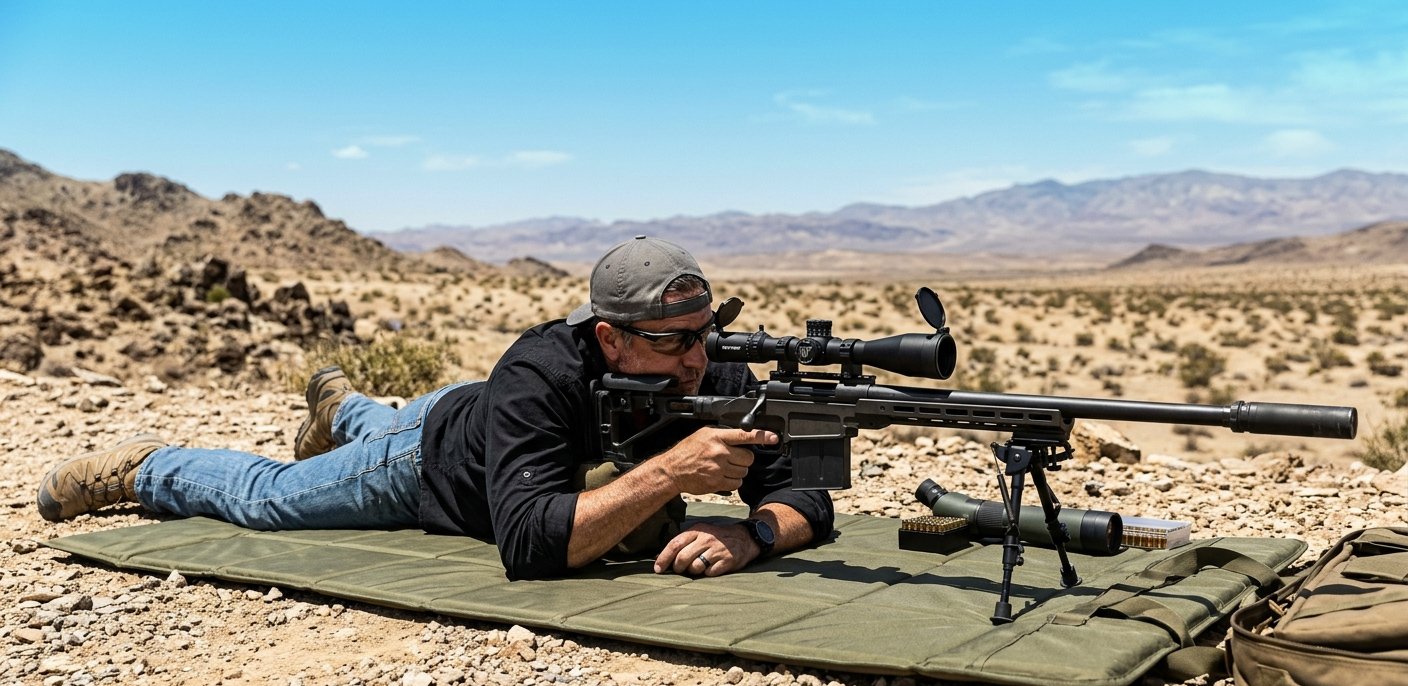
The Landscape of Precision Rifle Disciplines
Precision rifle shooting splits into distinct disciplines, each with its own history, gear requirements, and competitive culture. Benchrest emerged in the 1940s as the purest accuracy test.1 F-Class formalized in the 1990s as a prone, sling-supported long-range game. The Precision Rifle Series launched in 2012 and reshaped the entire industry around practical field shooting. Extreme Long Range pushed past a mile in the 2010s as ballistic solvers and premium glass made it accessible.
These are not arbitrary categories. Each discipline evolved to test a specific skill set, and the rifles that dominate each reflect that focus. A benchrest gun optimized for 0.1 MOA at 100 yards looks nothing like a PRS rifle built to transition between barricades under a shot clock. Understanding the disciplines helps you choose where to invest your time and what kind of rifle to build.
Benchrest: The Accuracy Standard
Benchrest shooting began in the post-WWII era when gunsmiths and handloaders started competing to see who could shoot the smallest groups. The discipline formalized in the 1950s with the establishment of rules, equipment classes, and sanctioning bodies like the International Benchrest Shooters (IBS) and the National Bench Rest Shooters Association (NBRSA).
The format is simple: fire a specified number of shots at paper targets from a bench, measure the groups, smallest wins. Distances range from 100 yards to 1,000 yards depending on the match format. Light Gun and Heavy Gun classes define weight limits. Unlimited class allows anything.
Benchrest rifles are purpose-built accuracy machines. Short, stiff actions. Heavy barrels with minimal whip. Stocks designed to ride sandbags with zero cant. Most competitors use custom actions (BAT, Kelbly's, Stiller) and hand-lapped barrels (Krieger, Bartlein, Brux). Calibers cluster around the 6mm family: 6 PPC for short-range, 6mm Dasher and 6 BRA for long-range. The goal is to eliminate every variable except the shooter's ability to read wind and execute a clean trigger break.
This is an individual sport. No spotter. No time limit. You bring your own front and rear bags, your own loading setup, your own wind flags. Matches are typically one-day affairs at established ranges. To find benchrest matches, check the IBS and NBRSA websites for registered clubs. Most clubs host monthly matches during the shooting season.
Benchrest set the standard for what rifles can do. When someone claims a factory rifle shoots 0.5 MOA, they are measuring against benchrest achievements. The discipline has declined slightly in participation since the 1990s as younger shooters gravitate toward PRS and tactical-style matches, but it remains the purest test of rifle accuracy.
F-Class: Prone Long-Range Precision
F-Class was invented in Canada in the mid-1990s by George Farquharson (the "F" stands for Farquharson, not "Farquharson Class" as sometimes claimed).2 The discipline formalized as a way for older shooters and those with physical limitations to compete in long-range shooting without the physical demands of standing or kneeling positions. Shooters fire prone with a front rest (usually a bipod) and a rear bag, at distances from 300 to 1,000 yards.
The sport grew rapidly in the 2000s and became an international discipline under the International Confederation of Fullbore Rifle Associations (ICFRA).3 F-Class matches are now held worldwide, with major competitions in the US, Canada, the UK, Australia, and South Africa.
F-Class splits into two equipment divisions: F-Open and F-TR. F-Open is unrestricted: any caliber, any weight, any scope, any front rest. Competitors typically run heavy 7mm or .284 caliber rifles with high-magnification scopes on bipods or mechanical rests. F-TR (Target Rifle) restricts competitors to .223 Remington or .308 Winchester, rifles under 18.18 pounds including scope, and bipods only (no mechanical rests).4 Most F-TR shooters run .308 for the ballistic advantage at 1,000 yards.
This is an individual sport, but coaching is allowed in some match formats. Shooters fire strings of 15 or 20 shots at paper targets with scoring rings. The targets are scored electronically or by pit crew, and the goal is to keep all shots in the X-ring (the center scoring zone). Wind reading is the primary skill being tested. A good F-Class shooter can hold inside 10 inches at 1,000 yards in moderate wind.
Required gear: a prone-capable rifle with a good trigger, a bipod (Harris or Atlas are common), a rear bag, a shooting mat, and a scope with enough magnification to resolve the target (most competitors run 25x to 45x at 1,000 yards). A Kestrel or wind meter helps but is not required. Many shooters use spotting scopes to call their own shots between strings.
To find F-Class matches, check the NRA High Power calendar, the F-Class.com forum, and local long-range clubs. Most matches are shot at 600 and 1,000 yards. Entry-level matches are welcoming to new shooters, and you will often find experienced competitors willing to walk you through the process.
Precision Rifle Series: The Paradigm Shift
The Precision Rifle Series launched in 2012 and fundamentally changed the precision rifle market.5 Before PRS, competitive long-range shooting was dominated by prone disciplines like F-Class and Palma. PRS introduced a field-shooting format: shooters engage multiple targets from improvised positions (barricades, rooftops, props) under a time limit, typically from 100 to 1,200 yards.
The format was borrowed from 3-Gun and USPSA, but applied to bolt-action rifles. Stages are timed. Misses cost points. Transitions matter. The fastest shooter with the most hits wins. The discipline exploded in popularity because it felt more practical than benchrest and more dynamic than prone shooting. By 2015, PRS had become the dominant competitive format in the US, and rifle manufacturers began designing guns specifically for the discipline.
PRS is an American invention, but the format has spread internationally. The Precision Rifle Series now sanctions matches in Europe, Australia, and South America. National series like the NRL (National Rifle League) and regional one-day matches offer entry points at every skill level.
The rifles that dominate PRS are purpose-built for the format. Medium-heavy weight (16 to 20 pounds), short to medium barrels (20 to 26 inches), chambered in 6mm or 6.5mm cartridges (6 Creedmoor, 6 Dasher, 6.5 Creedmoor, 6.5 PRC). Chassis systems (MPA, Foundation, MDT) are common because they allow the shooter to adjust length of pull and cheek height quickly. Scopes run 4-25x or 5-30x magnification with MIL-based reticles for fast holdovers. Bipods are standard, but most shooters also carry a rear bag and a .
This is an individual sport, but most matches allow a spotter. The spotter can call wind, read trace, and help the shooter find targets. Some shooters compete solo; others bring a dedicated spotter. The team dynamic is part of the appeal.
Required gear: a rifle capable of hitting a 12-inch target at 600 yards, a scope with a reticle you can use for holdovers, a bipod, a rear bag, a sling, 100 to 200 rounds of ammo per match, and a way to carry it all (most shooters use a backpack or drag bag). A Kestrel and a rangefinder are not required at local matches but become necessary as you move up to regional and national events.
To find PRS matches, check the PRS website for sanctioned club matches, or search for "PRS-style" matches on Practiscore. Most states have at least one active club. Entry-level matches are usually one-day affairs with 6 to 10 stages. Expect to shoot 100 to 150 rounds.
Extreme Long Range: Pushing Past a Mile
Extreme Long Range (ELR) is the newest precision discipline, and it formalized in the 2010s as ballistic solvers, high-BC bullets, and premium optics made shooting past a mile accessible to non-military shooters. The King of 2 Mile match, first held in 2015 in Raton, New Mexico, became the flagship event.6 Shooters engage targets from 1,500 yards to 3,520 yards (2 miles) in a multi-day competition.
ELR is less a standardized discipline and more a category of shooting. Some matches are King of 2 Mile-style (hit progressively distant targets, advance if you hit). Others are score-based (hit as many targets as possible in a time limit). Distances range from 1,200 yards to over two miles. The unifying factor is that shooters are engaging targets at ranges where transonic and subsonic ballistics come into play, and where environmental variables (density altitude, wind layers, Coriolis effect) dominate the equation.
This discipline is international. The King of 2 Mile has been held in France, Australia, and Ireland. The Nightforce ELR match series runs events across the US. The format is growing because it pushes the limits of what rifles and shooters can do.
ELR rifles are heavy. Most competitors run 25 to 35-pound guns with 28 to 32-inch barrels in magnum cartridges: .300 Norma Magnum, .300 PRC, .338 Lapua Magnum, .375 CheyTac, .416 Barrett. The goal is to keep the bullet supersonic as long as possible and to deliver enough energy on target to register a hit on steel. Scopes run 7-35x to 10-50x magnification with MIL reticles. Spotting scopes are mandatory because you need to see trace and splash at extreme distances.
This is a team sport in practice. Most ELR shooters work with a spotter who calls wind, reads mirage, and helps adjust for misses. Some matches require a spotter. The teamwork is part of the discipline.
Required gear: a rifle capable of staying supersonic past 1,500 yards, a high-magnification scope, a bipod or front rest, a rear bag, a Kestrel, a rangefinder, a ballistic solver (most shooters use Applied Ballistics or Strelok Pro), a spotting scope, and a lot of ammunition. ELR matches can require 50 to 100 rounds per day, and magnum cartridges are expensive to shoot.
To find ELR matches, check the King of 2 Mile website, the Nightforce ELR series, and regional clubs with access to long-range property. This is the least accessible discipline for new shooters because it requires specialized gear and access to ranges with targets past 1,200 yards. Most shooters come to ELR after competing in PRS or F-Class.
Palma and Fullbore: The International Tradition
Palma shooting is one of the oldest international rifle disciplines, dating back to 1876 when the first Palma match was held between teams from the US, Australia, and Ireland.7 The format is simple: shooters fire at 800, 900, and 1,000 yards from prone, standing, and sitting positions (depending on the match), using iron sights or scopes, in .308 Winchester or .223 Remington.
Palma is a team sport. National teams compete at the Palma World Championship every four years. The discipline remains popular in Commonwealth countries (UK, Australia, Canada, New Zealand) and has a dedicated following in the US. The NRA sanctions Palma matches, and the format is part of the Camp Perry National Matches.
Fullbore shooting is the umbrella term for all long-range prone shooting with centerfire rifles, including Palma and F-Class. In the UK and Commonwealth countries, Fullbore is a major competitive discipline with club matches, regional championships, and national teams. In the US, Fullbore is less common, and most long-range shooters gravitate toward F-Class or PRS.
Palma rifles are purpose-built for the discipline. Heavy barrels, precision triggers, adjustable stocks, and either iron sights or low-magnification scopes (most Palma shooters run 6x to 12x). The .308 Winchester dominates because it is the required caliber for international Palma matches. Shooters use slings and shooting jackets for positional stability.
This is a team sport at the national level, but individual competitions exist. Coaching is allowed in some formats. Required gear: a rifle in .308 or .223, a sling, a shooting mat, a spotting scope, and ammunition. Iron sights are traditional but not required in all matches.
To find Palma matches, check the NRA High Power calendar and local fullbore clubs. The discipline has a smaller competitive base than PRS or F-Class in the US, but it remains active at major ranges like Camp Perry and Ben Avery.
Relative Long Range: The Philosophy, Not the Discipline
Relative Long Range (RLR) is not a formalized discipline with sanctioning bodies or match formats. It is a shooting philosophy I developed: taking any caliber past its "effective" range to the point where drop and wind dominate the equation. The idea is that the challenge of shooting a .223 Remington to 800 yards is comparable to shooting a .338 Lapua Magnum to 2,000 yards. Both require the shooter to manage significant bullet drop, wind drift, and environmental variables.
I developed the RLR concept as a way to make long-range shooting more accessible. The idea: rifle builds that support taking any caliber past their "effective" range, so you find the same challenge at 800 yards with a .223 Remington that you might not find until you're past a mile with a .416 Barrett. You do not need a magnum cartridge or a $4,000 rifle to experience the challenge of extreme distances. You need a rifle that shoots straight, good glass, and a willingness to push the caliber past the point where the ballistics get easy.
RLR does not have matches or competitions. It is a training mindset and a way to approach rifle builds. Most of the rifles I build are RLR-focused: heavy barrels, long sight radius, premium scopes, chambered in cartridges that most shooters consider "too small" for the distances I shoot them. The goal is not to set records. The goal is to make the shooter work for every hit.
If you want to explore RLR, start by taking your current rifle 200 yards past where you normally shoot it. If you zero at 100 and confirm at 600, go to 800. See what happens when you have to dial 10 MIL of elevation and hold 2 MIL for wind. That is RLR.
How to Choose Your Discipline
The discipline you choose should match your goals, your gear, and your access to ranges. If you want to test pure rifle accuracy and you have access to a 100-yard range, benchrest is the answer. If you want to shoot long-range prone and you have access to a 1,000-yard line, F-Class is the natural fit. If you want dynamic field shooting with a shot clock, PRS is the obvious choice. If you want to push past a mile, ELR is the challenge.
Most shooters start in one discipline and migrate to others as their skills develop. I started in F-Class, moved to PRS for the stage variety, and now spend most of my range time on RLR builds that let me test wind calls at distances where the ballistics get hard. The disciplines are not mutually exclusive. The skills transfer.
The rifle you build should reflect the discipline you plan to shoot most often. A benchrest gun will not work in PRS. A PRS rifle will not be competitive in benchrest. An ELR rifle is too heavy for PRS and overkill for F-Class. Build for the game you want to play.
Getting Started: Finding Matches and Clubs
Every discipline has a national organization that sanctions matches and maintains a club directory. For benchrest, check the IBS and NBRSA websites. For F-Class, check the NRA High Power calendar and F-Class.com. For PRS, check the PRS website and Practiscore. For ELR, check the King of 2 Mile and Nightforce ELR series. For Palma and Fullbore, check the NRA and your national shooting association.
Most clubs welcome new shooters. Entry-level matches are designed to be accessible. You do not need a custom rifle or a $3,000 scope to shoot your first match. You need a rifle that shoots straight, a scope with a MIL reticle, and enough ammunition to finish the course of fire. Show up early, introduce yourself to the match director, and ask questions. The competitive shooting community is smaller than you think, and experienced shooters are usually happy to help.
If you cannot find a local club, consider traveling to a regional match. PRS and F-Class matches often draw shooters from multiple states. The investment in travel pays off in the form of coaching, networking, and exposure to better shooters. You will learn more in one weekend at a match than in six months of solo practice.
FAQ
What shooting discipline is best for beginners?
F-Class and local PRS club matches are the most beginner-friendly. F-Class has a slower pace, no time pressure, and a supportive community. PRS club matches are more dynamic but usually have experienced shooters who will walk you through the stages. Benchrest has a steeper learning curve because the accuracy standards are unforgiving.
Do I need a custom rifle to compete?
No. Most disciplines have factory rifle divisions or equipment classes that allow stock guns. A Tikka T3x in 6.5 Creedmoor with a Vortex scope will be competitive in entry-level PRS and F-TR matches. You do not need a custom action or a hand-lapped barrel to learn the fundamentals. Upgrade your gear as your skills improve.
Can I compete without a spotter?
Yes in most disciplines. Benchrest, F-Class, and most PRS club matches allow solo shooting. ELR matches often require or strongly encourage a spotter because reading trace and splash at extreme distances is difficult alone. If you plan to shoot ELR, find a shooting partner.
How much does it cost to get started in competitive shooting?
Entry fees range from $50 to $150 per match depending on the discipline and match level. Ammunition is the bigger cost: expect to shoot 100 to 200 rounds per PRS match, 60 to 80 rounds per F-Class match, and 20 to 40 rounds per benchrest match. Travel and lodging add up if you compete outside your region. Budget $200 to $500 per match weekend including entry, ammo, and travel.
If you want to explore RLR, start by taking your current rifle 200 yards past where you normally shoot it. I built my first RLR rifle around a .223 Remington specifically to force myself to read wind at 800 yards, which is the same challenge I face with a 6.5 Creedmoor at 1,200.
Citations
- (2026). Benchrest Shooting | The Boise Gun Club Handbook. Boise Gun Club.
- (2024). George "Farky" Farquharson - Dominion of Canada Rifle Association. Dominion of Canada Rifle Association.
- ICFRA Shooting Rules and Match Conditions. International Confederation of Fullbore Rifle Associations.
- (2024). F-CLASS RULES Official Rules and Regulations. National Rifle Association.
- About the Precision Rifle Series. Precision Rifle Series.
- King of 2 Miles: Extreme Long-Range Competition. NRA Shooting Sports USA.
- (1991). Classic SSUSA: The History of the Palma Trophy. Shooting Sports USA.