
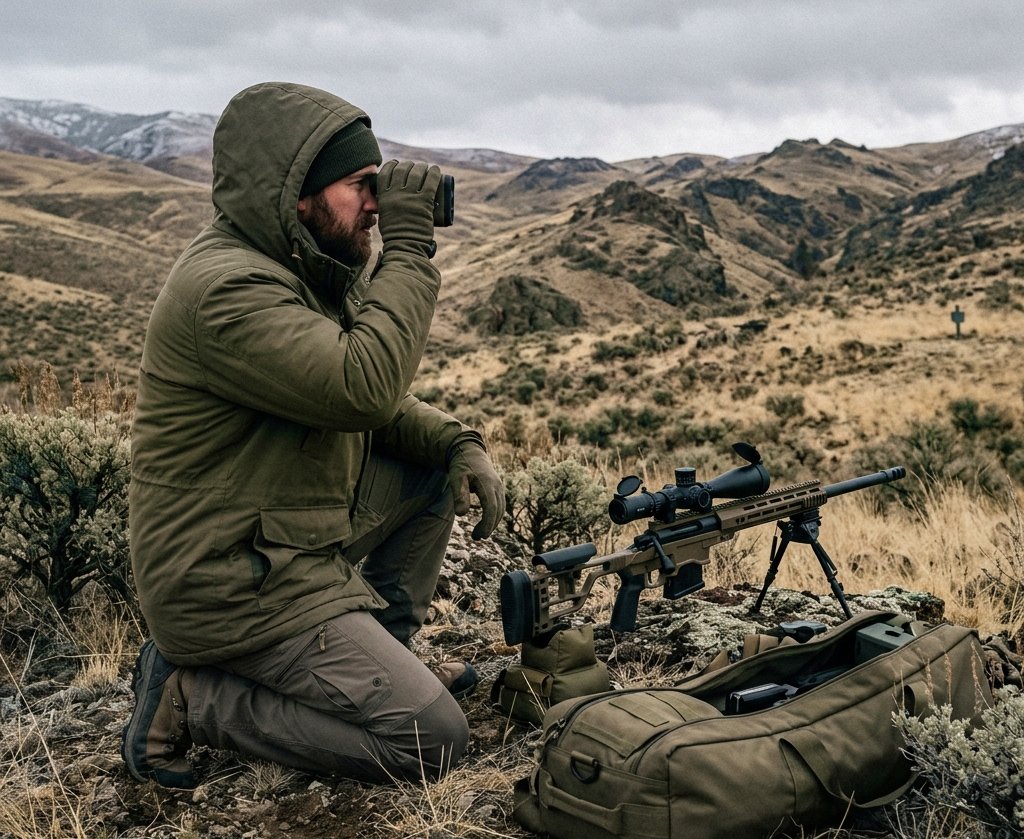
You need a laser range finder the moment you leave known-distance ranges. When you stretch a caliber to its limits taking a .223 Remington to 800 yards or a 6.5 Creedmoor to a mile, you need exact distance to the target. A 10-yard ranging error at 1,500 yards costs you 0.23 MIL of vertical on a 6.5 Creedmoor running 140gr at 2,700 fps. That's the difference between a center hit and a miss off the bottom of the plate (13 inches of mis-dialed difference).
The market splits into three tiers: budget units under $400, mid-tier from $600 to $1,200, and top-shelf units above $1,500. Each tier trades capability for cost. The question is which capabilities you actually need for the distances you shoot.
The Three Price Tiers and What You Get
Budget laser range finders top out around 1,200 to 1,500 yards on reflective targets. They use lower-powered lasers and simpler beam divergence profiles. Most lack Bluetooth connectivity and onboard ballistic solvers. You range the target, note the distance, and dial or hold based on your data book or a separate ballistic app. For known-distance practice or Relative Long Range work inside 1,000 yards, they're sufficient.
Mid-tier units extend ranging capability to 2,000 to 2,500 yards on cooperative targets. They add onboard angle compensation, better optics, and Bluetooth connectivity to pair with ballistic apps. Some include basic onboard solvers that output a firing solution in MIL or MOA. Build quality improves: better housings, more reliable buttons, and clearer displays in bright sunlight. This is the tier most precision shooters settle into.
Top-shelf laser range finders range steel past 3,000 yards. They incorporate full environmental sensors: temperature, barometric pressure, humidity, and compass heading. They connect to external ballistic engines via Bluetooth or ANT+, feeding range and environmentals directly into your solver. Some include onboard Applied Ballistics solvers with custom drag models.1 These units are built for ELR competition and extreme field conditions.
Onboard Ballistic Solvers vs Separate Apps
Onboard ballistic solvers simplify the workflow. You range the target, the unit calculates bullet drop and wind hold based on your stored rifle profile, and it displays a firing solution. One device, one readout, fast cycle time. The tradeoff is limited flexibility. Most onboard solvers use simplified drag models and don't allow the granular tuning you get with a dedicated app like Applied Ballistics or Strelok Pro.
I prefer a separate handheld solution for load development and that's also what I use when I shoot my rifle. A smartphone or Kestrel running a full ballistic solver gives you access to custom drag curves, truing from live fire data, and the ability to save multiple rifle profiles with different loads. You pair the laser range finder via Bluetooth, it feeds range and angle to the app, and the app outputs the corrected firing solution. The extra step is worth the precision when you're working at the edge of a cartridge's capability.
For field shooting or hunting where speed matters more than 0.1 MIL precision, an onboard solver makes sense. For match work or pushing a caliber to 1,800+ yards, run a dedicated app.
Ranging Engine Differences That Matter
Laser range finders differ in beam divergence, pulse rate, and receiver sensitivity. Beam divergence is the angle at which the laser spreads over distance. A narrower beam delivers more energy on target and reduces the chance of ranging foreground brush or mirage instead of the steel. High-end units use beam divergences under 0.5 mils. Budget units run 1.5 to 2.0 mils, which makes ranging small targets past 1,200 yards inconsistent.2
Pulse rate affects how quickly the unit can deliver a range reading. Faster pulse rates mean faster target acquisition and the ability to range through atmospheric interference like heat shimmer or light rain. Top-tier units pulse at rates allowing sub-second returns even on low-reflectivity targets.
Receiver sensitivity determines the unit's ability to detect faint returns from distant or non-reflective surfaces. Steel at 2,000 yards reflects less energy than a deer at 600 yards. Higher receiver sensitivity extends effective range on real-world targets, not just the manufacturer's claimed max range on a reflective test board.
Bluetooth Connectivity and Ballistic App Integration
Bluetooth connectivity turns your laser range finder into a ranging sensor for your ballistic solver. You range the target, the unit transmits distance and inclination angle to your phone or Kestrel, and the solver outputs the corrected elevation and windage hold. No manual data entry, no transcription errors, faster shot cycle.
Most mid-tier and all top-shelf units include Bluetooth.3 Some units use proprietary profiles that only pair with the manufacturer's app. Others are compatible with Applied Ballistics, Strelok, and Shooter. Check compatibility before you buy.
Latency is rarely an issue on modern units. Range transmission happens in under half a second. The limiting factor is usually the ballistic app's calculation time, not the Bluetooth link.
Specs That Actually Matter Past 1,500 Yards
Maximum advertised range is marketing. Manufacturers test on large reflective targets in ideal conditions. Real-world performance on steel in mirage and wind runs 60 to 75 percent of the advertised max. A unit rated to 2,500 yards will reliably range steel to about 1,800 yards in field conditions.4
Beam divergence under 1.0 mils is the threshold for consistent ranging past 1,200 yards. Anything wider and you start getting false returns from terrain features or atmospheric clutter.
Angle compensation is non-negotiable for field shooting. Shooting uphill or downhill changes the ballistic range versus the line-of-sight range. A unit without angle compensation forces you to calculate the cosine correction manually or rely on your ballistic app to do it, which requires you to input the angle separately.
Display readability in bright sunlight separates usable units from frustrating ones. OLED displays wash out in direct sun. Transflective LCDs or red LED readouts stay visible. If you shoot in open terrain at midday, test the display before you commit.
Battery life matters for multi-day matches or long field sessions. CR2 and CR123 batteries are common and easy to source. Some units use rechargeable internal batteries, which is fine until you're three days into a trip with no charging option. Carry spares.
When to Upgrade Your Laser Range Finder
You need a better unit when your current one stops delivering reliable ranges at the distances you shoot. If you're consistently shooting steel at 1,400 yards and your budget unit only ranges it half the time, upgrade to mid-tier. If you're running ELR matches past 2,000 yards and your mid-tier unit struggles in mirage, move to top-shelf.
The other upgrade trigger is workflow friction. If you're manually entering range and angle into a ballistic app on every shot and it's slowing you down, add Bluetooth connectivity. If you're running multiple rifles with different loads and your onboard solver can't handle the profiles, switch to an app-based solution.
Don't upgrade for features you won't use. A $2,000 laser range finder with an onboard Applied Ballistics engine is wasted if you shoot known-distance steel at 600 yards. Buy the capability you need for the shooting you do.
Practical Considerations for Heavy Rifle Shooters
Heavy rifles with long barrels and big glass don't care about the weight of your laser range finder, but they do care about your shooting position stability. Some shooters run a lanyard and let the unit hang while they shoot. Find a carry method that doesn't interfere with your prone setup or your bipod deployment.
Ranging through your scope is possible with some high-magnification optics, but it's slower than using a dedicated laser range finder. I range first, then get behind the rifle. That workflow keeps the rifle settled and lets me focus on wind reading and trigger control once I'm in position.
FAQ
Do I need a laser range finder with an onboard ballistic solver?
No, unless speed matters more than precision. A separate ballistic app on your phone or Kestrel gives you better drag models, custom truing, and more rifle profiles. Onboard solvers are faster but less flexible. For ELR and load development work, run a dedicated app.
What's the real-world max range on a unit rated to 2,500 yards?
Expect 60 to 75 percent of the advertised max on steel in field conditions. A 2,500-yard unit will reliably range steel to about 1,800 yards in mirage and wind. Advertised specs assume large reflective targets in ideal conditions.
Does beam divergence matter for shooting inside 1,000 yards?
Less than it does past 1,200 yards, but it still affects reliability on small targets. A narrower beam reduces false returns from foreground clutter and makes it easier to range the actual target instead of the berm behind it. Under 1.0 mil is the threshold for consistent performance.
Can I use my hunting range finder for ELR shooting?
If it ranges reliably to your target distance and gives you angle compensation, yes. Most hunting units top out around 1,200 yards and lack Bluetooth connectivity, so you'll be manually entering data into your ballistic solver. That's fine for practice but slow for match work.
Citations
- Custom Drag Factor (CDF) / Custom Drag Models. Applied Ballistics.
- (2026). How Does a Rangefinder Work? Complete Guide (2026). Revell Photography.
- (2022). The Right Rangefinder. Shooting Sports Retailer.
- Cal Zant. (2019). Pocket Rangefinder Field Test Showdown. Precision Rifle Blog.