
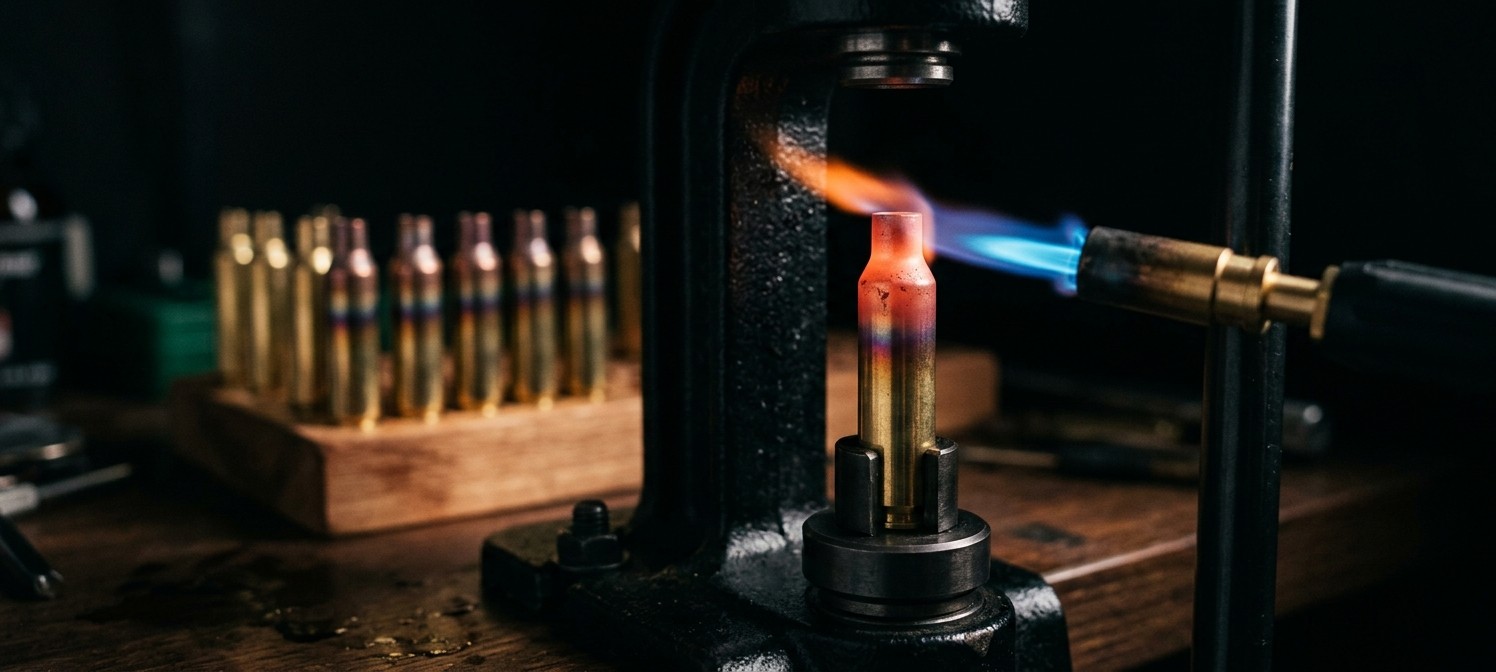
Annealing brass is one of those reloading steps that gets talked about like a secret handshake, half metallurgy and half folklore, and it is easier to understand than the mystique suggests. Every time you fire a case and run it through a sizing die, the brass at the neck gets a little harder and a little springier, which slowly changes how it grips the bullet and eventually splits it. Annealing is simply a controlled heating that softens that neck back toward its original state, so the case grips the bullet the same way it did when it was new. Done right, it gives you longer case life and steadier neck tension. Done wrong, it ruins good brass or, in the worst case, makes a case unsafe. This guide explains what annealing brass actually fixes, what it does not, and how to judge whether it is worth the time and money for the way you shoot.
The realistic version matters here, because annealing is oversold as a cure-all and undersold as a safety topic at the same time. It is a real, useful process with clear benefits and a couple of hard rules you cannot break. By the end you will know why brass hardens, what the heat restores, where the danger lives, and whether your shooting is the kind that benefits from this step.
Why brass hardens every time you load it
Brass is not a static material, it changes its character every time it is worked. When the case expands and then contracts in a rifle chamber, or is sized as part of the reloading process, it is work hardened.1 Each firing balloons the case to fit the chamber, each pass through the sizing die squeezes it back down, and every one of those cycles rearranges the metal's internal structure to make it harder and less springy than before. The neck, which gets worked the most, hardens the fastest.
That hardening is the root of two problems a reloader eventually meets. The first is inconsistent neck tension, because a harder neck grips the bullet differently than a soft one, and as your cases harden at slightly different rates the grip varies from case to case. Since that grip influences how the bullet releases and how pressure builds, inconsistent neck tension feeds straight into velocity spread, the very thing precision handloading tries to minimize.
The second problem is more final, which is that work-hardened brass eventually cracks. A neck that has lost its ductility becomes brittle, and at some point it splits on firing or sizing, ending that case's life. This is why a batch of brass that started uniform slowly turns into a mix of soft and hard, tight and loose, until split necks start appearing and the batch is no longer trustworthy. The hardening is doing all of that quietly in the background of every load cycle.
What annealing actually restores
Annealing is the deliberate reversal of that hardening. Annealing is a process that heats the brass case to make it softer and more ductile, effectively reversing the work hardening process.2 By bringing the neck and shoulder up to the right temperature for a short time, you let the metal reset toward the soft, pliable state it had when the case was new, which is why annealing is sometimes described as returning the brass partway to virgin condition.
What happens inside the metal is a genuine structural change, not just a surface effect. Heating the brass to the annealing temperature provides enough thermal energy for the atoms to rearrange themselves and forms new, equiaxed grains, relieving internal stresses and restoring the brass ductility and malleability.3 The hardened, stressed grain structure that built up over firings is replaced by fresh, relaxed grains, which is the physical reason the neck becomes soft and uniform again.
That reset gives you the two things hardening was taking away. First, it evens out the grip, because annealing ensures that the brass neck returns to a uniform hardness, providing consistent neck tension shot after shot.4 Second, it pushes back the day the brass cracks, since annealed brass is less likely to crack during subsequent firings and resizing operations, significantly extending the usable life.5 Longer case life and steadier neck tension are the two solid, well-supported reasons to anneal.
What annealing does not fix
Annealing holds a place in your process, but it is not magic, and believing it is will only disappoint you. It restores the neck and shoulder. It does nothing for the body or the head of the case, so the slow stretching that leads to incipient case head separation is untouched by annealing, and a case approaching that failure is done regardless of how perfectly you anneal the neck. Annealing is a neck-and-shoulder treatment, not a whole-case rejuvenation.
It also will not rescue a load that has other problems. If your velocity spread is wide because you throw powder charges by eye, or your groups are open because of a worn barrel or a poor scope mount, annealing will not close them up. Consistent neck tension is one input among many, and it only helps once the bigger variables are already under control. A reloader chasing accuracy is better served by weighing charges carefully and bedding the rifle before worrying about annealing.
And annealing does not make brass last forever. It extends case life by delaying the cracking that hardening causes, but the case body still stretches, primer pockets still loosen with pressure, and brass still wears out. The realistic claim is that annealing removes one of the common reasons brass gets retired early, the split neck, and keeps neck tension steadier along the way. That is a worthwhile benefit, but it is a specific one, not a promise of immortal cases or instant precision.
The temperature window, and the line you never cross
Annealing is a narrow target, and both edges of the window matter. The ideal annealing temperature for brass typically ranges from 600F to 800F (315C to 420C) for quick torch methods,6 reached for just a few seconds on the neck and shoulder. Too little heat and you have not annealed at all, you have merely warmed the case. Too much heat, or heat held too long, and you push past softening into ruining the brass, leaving the neck so soft it can no longer hold a bullet properly.
The line you never cross is heat reaching the case head. The base and web of the case are what contain the firing pressure, and they must stay hard. Over-annealing occurs when too much heat is applied and can soften the base of the case, which is critical for structural integrity, potentially leading to dangerous case failures upon firing.7 A neck annealed too soft is a wasted case; a head annealed soft is a safety hazard, because a weakened case head can let go under pressure. This is the one rule in annealing you treat as absolute.
Two practical habits keep you safe inside the window. Use a temperature indicator such as a heat-sensitive lacquer to confirm the neck reaches annealing heat while the area near the head stays well below it, so you are measuring rather than guessing. And protect the base from heat, which is the logic behind the old water-pan method, where the water served as a heat sink for the bottom of the case, which you do not want to soften.8 Heat the neck quickly, keep the head cool, and verify it, and you stay on the right side of both edges.
How to anneal without a four-figure machine
You do not need an expensive machine to anneal, though you can buy one. The traditional method is a propane or butane torch and a way to spin the case, where you rotate the neck and shoulder in the flame for a few seconds until they reach temperature, then drop the case to cool. With a heat-sensitive lacquer to tell you when the neck is hot enough and a setup that keeps the flame off the case head, a torch and a drill or a simple spinner can anneal brass for the cost of the torch and the indicator.
The trade-off with the torch method is consistency, because doing it by hand makes it hard to apply exactly the same heat for exactly the same time to every case. That variability is the enemy of the uniform neck tension you are annealing to get, so the more repeatable your timing and flame position, the more the process actually helps. A flame method with careful, identical technique works, but sloppy timing can leave you with necks annealed to slightly different degrees, which undercuts the point.
This is what the machines are selling, repeatability. Induction annealers heat the neck electrically for a precisely timed interval, so every case sees the same energy, and motorized torch fixtures feed and time cases the same way each cycle. They cost real money, from a few hundred dollars for a torch fixture to four figures for a good induction unit, and what you are paying for is uniformity, not a different result. My approach is to start with a torch and a temperature indicator to learn whether annealing helps my shooting at all, and to spend on a machine only once consistency is the thing holding me back.
Is it worth it for the budget reloader
Whether annealing pays depends entirely on what you shoot and how you value your brass. For high-volume practice with cheap factory ammo, or for a hunting rifle that fires a box a year, annealing is usually not worth the bother, because you are not chasing the last increment of consistency and your brass is either disposable or barely worked. The plain answer for a lot of shooters is that their time is better spent elsewhere.
The case for annealing gets strong in two situations. The first is expensive or hard-to-find brass, where extending case life directly saves money, and a reloader with costly cases for an obscure cartridge can justify annealing purely on the brass it preserves. The second is precision handloading at distance, where the steadier neck tension can shrink velocity spread enough to matter on a small target far away, which is exactly where consistent neck tension pays off most.
So the budget-minded way to think about it is to match the effort to the payoff. If you reload cheap, plentiful brass for general practice, skip it and put the money toward components or range time. If you shoot precision at long range, or you reload brass that is genuinely expensive to replace, annealing is one of the better-justified steps in your process. Start cheap with a torch to find out which camp you are in, and scale up only if the results on your own targets and your own brass tell you it is worth it.
FAQ
What does annealing brass actually do?
Annealing brass heats the case neck and shoulder for a few seconds to soften metal that hardened from firing and sizing. The heat lets the grain structure reset toward its original soft, ductile state, which restores uniform neck tension and makes the brass less likely to crack. It treats only the neck and shoulder, not the body or head, so it improves grip and extends case life without rejuvenating the whole case.
What temperature do you anneal brass at?
The common target for quick torch annealing is roughly 600 to 800 degrees Fahrenheit at the neck, held for only a few seconds. Below that the brass is merely warmed, not annealed, and well above it the neck becomes too soft to hold a bullet. A heat-sensitive lacquer is the reliable way to confirm the neck reaches annealing heat while the case head stays cool, since judging the color by eye is unreliable.
Can annealing brass be dangerous?
It can be if heat reaches the case head. The base and web of the case contain the firing pressure and must stay hard, and softening them through over-annealing can lead to dangerous case failures on firing. The rule is to heat the neck and shoulder quickly while keeping the head cool, protecting the base and verifying neck temperature with an indicator. A neck annealed too soft only wastes a case; a softened head is a real hazard.
Is annealing brass worth it for a budget reloader?
It depends on what you shoot. For high-volume practice or a low-round-count hunting rifle, annealing brass is usually not worth the time. It pays off when your brass is expensive or hard to find, since longer case life saves real money, or when you shoot precision at long range, where steadier neck tension can tighten velocity spread. Starting with an inexpensive torch and a temperature indicator is a cheap way to find out which camp you are in.
Citations
- (2016). Annealing brass for reloaders. RifleShooter.
- (2016). Annealing brass for reloaders. RifleShooter.
- (2024). Annealing Brass Cartridge Cases. Ithy.
- (2024). Annealing Brass Cartridge Cases. Ithy.
- (2024). Annealing Brass Cartridge Cases. Ithy.
- (2024). Annealing Brass Cartridge Cases. Ithy.
- (2024). Annealing Brass Cartridge Cases. Ithy.
- (2016). Annealing brass for reloaders. RifleShooter.