
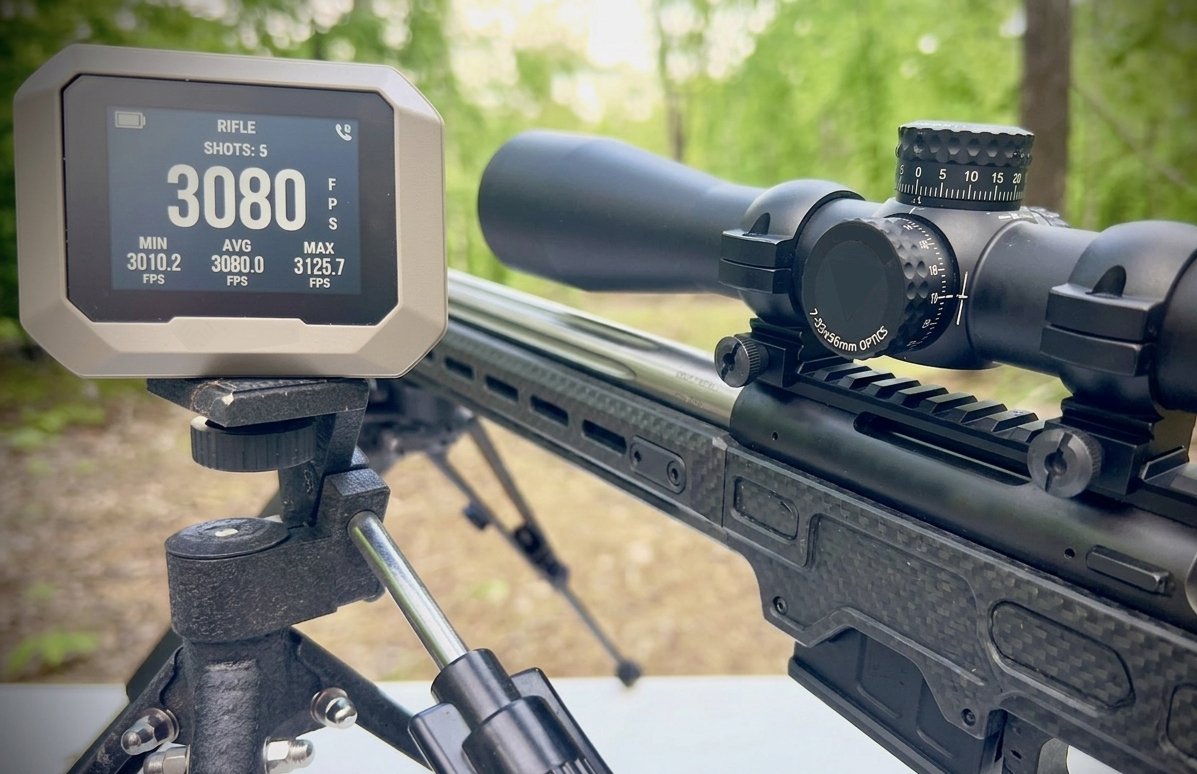
A chronograph is the one tool that turns guesswork into data. It reads how fast your bullet is actually moving, and that single fact anchors every drop and wind call you make downrange. Understanding what a rifle chronograph measures is what lets you trust your trajectory instead of hoping it is right. This guide walks through the numbers it reports, why each one matters at distance, and the modern units that read them.
Muzzle velocity: the number that anchors everything
The headline figure a chronograph reports is muzzle velocity, the speed of the bullet as it leaves the barrel. It is measured in feet per second, and it is the single most important input to any ballistic solver. Without it, the math cannot predict where the bullet lands.
A solver builds your trajectory from muzzle velocity, ballistic coefficient, and atmospheric data. Feed it a guessed speed and every come-up inherits that error. Manufacturer advertised velocities come from test barrels and rarely match a real rifle within 50 to 100 feet per second. So you measure your load, in your rifle, at the temperature you plan to shoot.
The cost of a velocity error grows with distance. Get muzzle velocity wrong by 30 feet per second and your 1,000-yard elevation is off by roughly 0.2 mils, enough to walk a shot off a steel target. That is the whole case for owning a chronograph: it replaces a number you assumed with one you measured.
Temperature is another variable worth tracking here. Most powders speed up as they warm and slow down as they cool, so a load chronographed at 70 degrees may print noticeably faster on a hot range day. Reading muzzle velocity in the conditions you actually shoot keeps your solver accurate, which is why the number is worth measuring more than once.
Standard deviation and extreme spread: the consistency story
Raw speed is only half the picture. The other half is consistency, and a chronograph reports it through two statistics that every reloader learns to read together.
Standard deviation describes how tightly your shot velocities cluster around their average. About two-thirds of your shots fall within one standard deviation of the mean, and about 95 percent fall within two. A precision load aims for single digits. Lower numbers predict smaller vertical dispersion at distance.
Extreme spread is simpler: the fastest shot minus the slowest across a string. Under 10 feet per second is the target for a tuned load, while anything over 30 is a load that has not settled. Extreme spread reacts hard to a single outlier, so one squib or one hot round inflates it while barely moving the standard deviation.
Why does this matter past 1,000 yards? Velocity variation becomes vertical error on target.1 At 1,000 yards even a 10 feet per second spread can move impact several inches up or down, and at 1,500 it can stretch toward six feet of vertical scatter. A small chronograph number on the bench becomes a large miss on the steel. This is exactly the thesis behind relative long range: a load tuned for low velocity spread reaches its practical ceiling regardless of caliber.
Optical, magnetic, and doppler: how chronographs read speed
Chronographs measure the same speed three different ways, and the method shapes how you use the tool.
Optical units read the bullet's shadow as it crosses two light sensors a known distance apart, then compute speed from the time between. They are affordable and proven, but they want good, even light and a careful setup downrange of the muzzle.
Doppler radar takes a different approach entirely. It reads the frequency shift in radar waves bouncing off the moving bullet, and because it tracks the projectile in flight it can report speed at many points along the path, not just at the muzzle.2 The original LabRadar popularized this approach for shooters and can even help derive a measured drag curve for one specific bullet.
The newest magnetic-and-radar units folded that capability into something pocket-sized. The Garmin Xero C1 Pro uses radar in a device the size of a deck of cards, sits beside the rifle rather than downrange, and logs every string to an app. Garmin specifies accuracy within 0.1 percent across a velocity range of 100 to 5,000 feet per second.3 That accuracy is a big reason the unit caught on so fast. For most shooters the practical benefit is simple: it just works, in any light, with almost no setup.
Setup separates the two families in practice. An optical screen has to sit a few feet downrange and squares to the muzzle, and it performs poorly in flat or failing light. A radar unit parks next to the rifle and reads in shade, sun, or snow. That convenience is why radar has become the common choice on the firing line for serious load work.
If I were building a load from scratch, I'd chronograph every step rather than chase group size alone. My approach is to fire a charge ladder across the unit and watch for a velocity flat spot, the charge window where adding powder barely moves speed. That flat spot tends to mark a stable node, and I'd settle the load there.
I prefer to read standard deviation and extreme spread together, never one alone, because they describe different failures. Then I'd confirm the final load over a full ten-shot string before I ever trust the number in a solver. The chronograph does not make the load; it tells you the truth about the one you built.
A measured muzzle velocity makes your dope trustworthy out to the practical limit of the cartridge, and a low velocity spread keeps your vertical tight when the distance gets long.
FAQ
What does a rifle chronograph actually measure?
A rifle chronograph measures the speed of your bullet, most often the muzzle velocity in feet per second just past the barrel. Modern units also log each shot and compute consistency statistics like standard deviation and extreme spread for the whole string.
Why does muzzle velocity matter so much for long-range shooting?
Muzzle velocity is the primary input a ballistic solver uses to predict drop and wind. An error of just 30 feet per second shifts your 1,000-yard elevation by roughly 0.2 mils, so a measured velocity is what makes your trajectory trustworthy.
What standard deviation and extreme spread should a precision load show?
A tuned precision load aims for single-digit standard deviation and an extreme spread under 10 feet per second. Double-digit extreme spread under 20 is workable, while anything over 30 signals a load that has not settled.
Is the Garmin Xero or LabRadar better for measuring chronograph data?
The LabRadar pioneered affordable doppler radar and can capture downrange velocity for drag work, while the Garmin Xero C1 Pro is smaller, sits beside the rifle, and runs in any light. For most shooters the Garmin's ease of setup makes it the simpler daily chronograph.
Citations
- Bryan Litz. (2020). BC and SD Effects on Vertical Dispersion. Applied Ballistics, LLC.
- LabRadar. (2023). LabRadar Doppler Radar Chronograph. LabRadar.
- Garmin. (2024). Xero C1 Pro Chronograph. Garmin.