
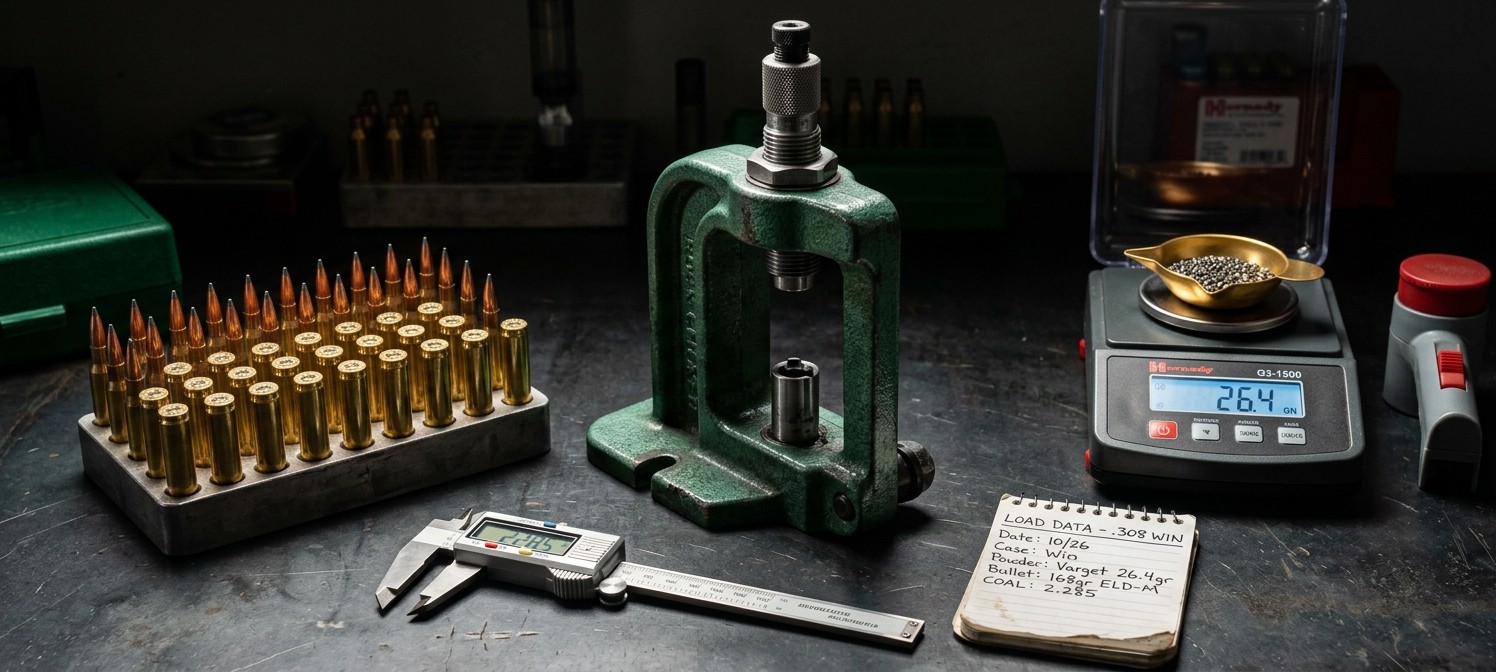
Load development is wrapped in more folklore than almost anything else in shooting, full of magic nodes, velocity flat spots, and one-shot ladder tests that promise to reveal your rifle's secret sweet spot. Most of that ritual does not survive contact with statistics, because the patterns it chases are usually random noise dressed up as meaning. The good news is that a plain, repeatable method works better than the voodoo, costs about the same in components, and gives you a load you can actually trust. You do not need to read tea leaves in a three-shot group. You need a sensible process and enough rounds to tell signal from noise.
This guide lays out that process. It explains why the traditional small-sample rituals find phantom nodes, then walks through a repeatable path for choosing a charge and a seating depth that holds up under real testing. The goal is a load you developed on evidence rather than superstition, and a method you can repeat the next time with confidence.
Why the voodoo persists
The old load-development rituals feel scientific, which is exactly why they fool people. You fire one shot at each of ten charge weights, plot where they land or how fast they went, and look for a spot where the numbers seem to settle, a node or flat spot you then declare your magic load. The pattern looks real on the target, and finding it feels like discovery, so the method spreads.
The trouble is that a one-shot or three-shot sample is far too small to mean anything, and the patterns it shows are mostly chance. When you use the small sample sizes that everyone uses for these tests, you will see consistencies in accuracy and velocity that are really just random noise within the outer limits of the system.1 The apparent node is your eye finding order in scatter, not a real property of the load.
This is the same statistical trap that makes a tight three-shot group misleading. Three shots forming a tight cluster is nice to look at, but it is little more than an accident, and the same is true of a smooth-looking spot in a one-shot ladder.2 The ritual persists because small samples reliably produce convincing illusions, and convincing illusions are hard to give up.
The ladder-test and magic-node myth
The strongest evidence against the folklore comes from shooting the same test with bigger samples. When researchers increased their sample sizes, they saw all of those imaginary nodes disappear,3 which is the result you would expect if the nodes were noise all along. A pattern that vanishes when you collect more data was never a real feature of the rifle, it was a coincidence you mistook for a signal.
The deeper finding is that charge weight is far less magical than the rituals assume. Across a sensible range of charges, the groups and velocity spreads come out broadly similar, so they are all going to shoot about the same, except that lower charge weights trend toward producing slightly tighter groups.4 There is no knife-edge node where everything snaps into focus, just a broad window where the load works, which is a much friendlier picture than the folklore paints.
This does not mean charge weight is irrelevant, only that it is not the precise, fragile thing the magic-node story claims. You are choosing a charge from a wide workable range based on safety, velocity, and consistency, not threading a needle to find the one weight that unlocks accuracy. Letting go of the magic node is the first step to a method that actually repeats.
The repeatable method, in outline
A method that survives statistics rests on one principle: use enough rounds to tell signal from noise, and judge loads on real metrics rather than patterns in tiny samples. In practice that means working up a safe charge, confirming it with a chronograph and a real group rather than a single shot, then tuning seating depth across a forgiving range and confirming again. The whole thing is less mystical and more like ordinary measurement.
The payoff for the bigger samples is that the answer is trustworthy and the process is efficient overall. It might feel wasteful to shoot twenty rounds of a candidate load instead of one shot each at twenty charges, but the larger sample tells you the truth in one sitting. As one tester puts it, you will either have your load development done or scrap that powder within twenty or thirty shots,5 which is faster than chasing phantom nodes across multiple range trips.
The steps below fill in that outline. First the charge, chosen for safety and consistency from a wide window. Then the seating depth, tuned for a forgiving range rather than a single magic gap. Then a confirmation that the whole thing holds up. None of it requires reading meaning into three-shot groups.
Charge weight: work up safely, judge on real data
Start by working the charge up safely from a published starting load, increasing in small steps and watching for pressure signs, never beginning at or above maximum. This part is about safety and is non-negotiable, since the goal is a charge that reaches the velocity you want without overpressure in your rifle, your brass, and your conditions. Let the manual and the pressure signs, not a forum's pet load, set your ceiling.
Within that safe range, you have a wide window to choose from, so pick the charge on evidence rather than a node. Chronograph a real string at a couple of promising charges and look at the velocity spread, because low extreme spread and standard deviation indicate stable internal ballistics and repeatable performance,6 which is what keeps your shots from stringing vertically at distance. A charge that delivers your target velocity with a tight, repeatable spread is the one to keep.
Resist the urge to over-interpret tiny differences. Because the workable window is wide and lower charges often group slightly tighter, you usually do not need the hottest load, just a safe one with a good spread and enough speed for your distances. Choose that charge and move on to seating depth, rather than agonizing over a tenth of a grain the statistics cannot even resolve.
Seating depth: tune for a forgiving range
With the charge chosen, seating depth is the fine-tuning step, and here a methodical ladder genuinely helps because it tests one variable cleanly. Load small groups at several jumps, such as 0.040, 0.050, 0.060, 0.070, 0.080, 0.090, 0.100, 0.110, and 0.120 inches, keeping everything else constant, and shoot them to see where your combination groups tightest.7 This is a real test because it changes only the seating depth and reads the result on the target.
What you are looking for is a forgiving range, not a single magic depth. A seating depth that shoots well across several thousandths is far more useful than one that only works at one exact setting, because the forgiving load stays in tune as your throat erodes and your hands vary. My approach is to pick a depth in the middle of a good range, with margin on both sides, rather than the single tightest group at the edge of a cliff.
Use enough rounds at each depth that the result is real, and judge on the same evidence as the charge step. A depth that produces a tight group and a low velocity spread across an adequate sample is a genuine finding, while a tiny group from three rounds is the same accident that fools the charge-weight ladder. Apply the larger-sample discipline here too, and your seating choice will hold up.
Confirm with a real sample
The final step is the one the folklore skips, which is confirming your chosen load with a sample large enough to trust. Shoot a ten-shot group or more at your final charge and seating depth, because a ten-shot group is a far better indicator of the true dispersion of a rifle and ammunition combination than the small groups the rituals rely on.8 If that larger group holds together and the velocity spread stays low, you have a real load.
This confirmation is what separates a developed load from a lucky one. You cannot draw a firm conclusion about a load from a single small group, because it often takes many groups to see the real average emerge, so the larger confirmation sample is the proof that your earlier choices were signal and not noise. If the big group opens up, you learned something true and cheap, before you trusted the load on a shot that mattered.
Once a load passes that confirmation, record everything and true your solver to it. The load that survived a real sample size is the one to load in quantity, write on your data card, and trust at distance, which is the whole point of developing it carefully in the first place. A confirmed load is worth far more than a clever-looking node you never verified.
Why this method survives the statistics
The reason this plain process beats the rituals is simply that it respects sample size at every step. It judges loads on velocity spread and group size measured over enough rounds to be meaningful, rather than on patterns in one-shot or three-shot data that are mostly chance. Every choice it makes is one a larger sample would confirm, which is exactly what the magic-node method cannot promise.
It is also more realistic about what a charge weight does. Instead of pretending there is a fragile node to find, it accepts a wide workable window and picks a safe, consistent charge from it, then spends its precision where it actually pays, on seating depth and on confirmation. That allocation matches where the real, repeatable gains live, instead of chasing artifacts in the charge ladder.
Held together, the method turns load development from a superstition into a measurement. Work up safely, choose a charge with a low spread from a wide window, tune seating depth for a forgiving range, and confirm with a real sample, and you end up with a load you can defend with data. The voodoo was never doing the work, and the plain method does it better.
FAQ
Why are ladder tests and magic nodes considered a myth?
Because they rely on sample sizes far too small to mean anything, so the nodes they find are usually random noise rather than real features of the load. When researchers shot the same tests with larger samples, the apparent nodes disappeared. A one-shot or three-shot ladder reliably produces convincing patterns that do not repeat, which is the definition of a statistical artifact.
How many rounds do I need for real load development?
Enough to tell signal from noise, which means judging charges and seating depths on strings of several rounds and confirming your final load with a ten-shot group or more. A ten-shot group is a far better indicator of true dispersion than the three-shot groups the rituals use. Many shooters can finish or rule out a load within twenty or thirty rounds using larger samples.
Does charge weight really matter for accuracy?
It matters, but not in the fragile, knife-edge way the magic-node story claims. Across a safe range, groups and velocity spreads come out broadly similar, with lower charges often grouping slightly tighter, so you choose a charge from a wide window rather than threading a needle. Pick a safe charge with a low velocity spread and adequate speed, and do not agonize over a tenth of a grain.
What is the repeatable way to develop a load?
Work the charge up safely from published data while watching pressure, then use a chronograph to pick a charge with low ES and SD from the workable window. Tune seating depth in a clean ladder, choosing a forgiving range rather than a single magic depth. Finally, confirm the load with a ten-shot group or larger, record it, and true your solver. Every step uses enough rounds to trust the result.
Citations
- Tyler Freel. (2024). Rifle Nodes: How You've Been Wasting Your Time and Money on Load Development. Outdoor Life.
- Cal Zant. (2020). Precision & Group Size: Statistics for Shooters Part 3. PrecisionRifleBlog.com.
- Tyler Freel. (2024). Rifle Nodes: How You've Been Wasting Your Time and Money on Load Development. Outdoor Life.
- Tyler Freel. (2024). Rifle Nodes: How You've Been Wasting Your Time and Money on Load Development. Outdoor Life.
- Tyler Freel. (2024). Rifle Nodes: How You've Been Wasting Your Time and Money on Load Development. Outdoor Life.
- Brandon Lolkus. (2025). Ladder Testing vs. OCW: Understanding ES/SD in Load Development. Red Leg Guns.
- Cal Zant. (2020). Bullet Jump Research: Executive Summary. PrecisionRifleBlog.com.
- Cal Zant. (2020). Precision & Group Size: Statistics for Shooters Part 3. PrecisionRifleBlog.com.