
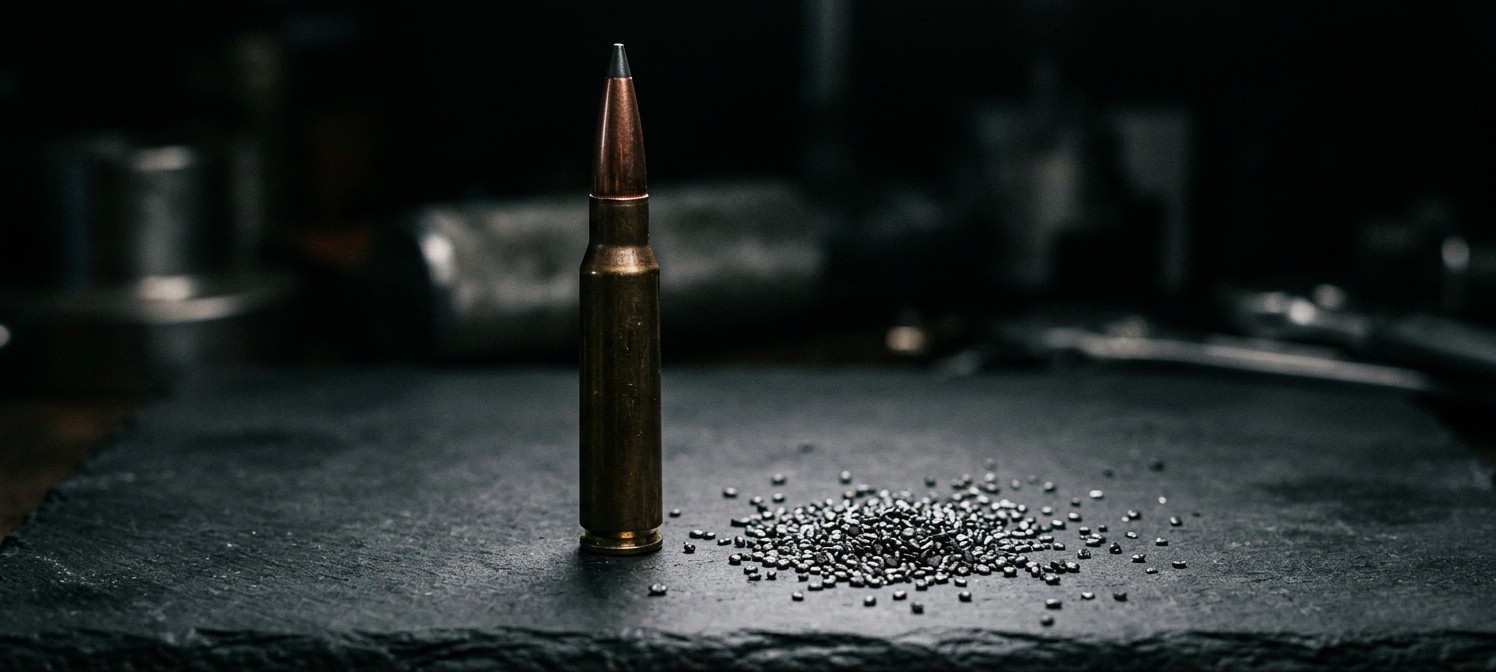
There is a point in every cartridge design where adding more powder stops being worth it. That point is what the word overbore is really about. Pour more powder behind a bullet and you do gain velocity, but each extra grain adds less speed than the one before, while the costs keep climbing in a straight line. Past a certain ratio of case volume to bore size, you are burning a lot of powder to gain a little velocity, and the tradeoffs are barrel life, harder load tuning, recoil, and money. Cartridge case capacity and overbore are simply the language for where a given round sits on that curve. Knowing it helps you choose a cartridge that gives you most of the performance for far less of the cost.
This guide defines case capacity and the overbore ratio in plain terms, shows why more powder delivers diminishing returns, and lays out what overbore actually costs. It then points to the efficient sweet spot that suits budget and high-volume shooting, where you get nearly all the achievable velocity with the least powder. The goal is to answer the practical question hiding inside the jargon: how much powder is too much for the shooting you do.
Case capacity and what overbore means
Case capacity is just the internal volume of the cartridge case, the room available for powder, usually measured in grains of water the case will hold. A bigger case holds more powder, and more powder behind the same bullet generally means more velocity, which is the whole reason large cases exist. So far this is simple: more room, more powder, more speed.
Overbore is what happens when that case capacity grows large relative to the size of the bore it feeds. An overbore cartridge is one with a relatively large case volume coupled with a relatively small diameter bullet. It is trying to push a lot of gas through a narrow hole. The case can hold more powder than the bore can efficiently turn into velocity, which is the root of every downside that follows.
The opposite of overbore is an efficient or balanced cartridge, where the case capacity is well matched to the bore. These rounds use a modest powder charge to reach most of the velocity the bullet is capable of, wasting little. Where a cartridge sits between efficient and overbore shapes its barrel life, its ease of tuning, its recoil, and its running cost, which is why the ratio is worth understanding before you buy.
The overbore ratio: case volume against bore
The cleanest way to compare cartridges is a ratio of how much powder they hold to how big a hole that powder has to work through. The common version is the overbore index, the case capacity in grains of water divided by the cross-sectional area of the bore. The higher that number, the more overbore the cartridge is. It captures in a single figure whether a case is reasonably matched to its bore or stuffed with more powder than the bore can use well.
A related idea is the expansion ratio, which is the total volume of the bore compared to the volume of the case, describing how many times the gas expands by the time the bullet reaches the muzzle. A cartridge with a small case and a long bore lets the gas expand a lot, extracting most of its energy before the bullet leaves, which is efficient. An overbore cartridge with a huge case and a normal bore lets much of the gas exit still under high pressure, spent as muzzle blast rather than useful push.
You do not need to compute these numbers to use the idea. The point is that a cartridge can be ranked on a scale from efficient to overbore by how its powder room compares to its bore, and that ranking predicts most of the trade-offs. Mild, balanced cartridges sit at the friendly end, and the big magnums that chase the last bit of velocity sit at the expensive end.
Diminishing returns: more powder buys less
The reason overbore is a real limit and not just a label is the law of diminishing returns. Adding powder to a given bore raises velocity, but not in proportion. Each additional grain has to accelerate not only the bullet but all the gas already in the barrel. Past the efficient point, you might burn ten percent more powder to gain two or three percent more velocity, a trade that gets steadily worse the further you push it.
This is why the velocity gap between an efficient cartridge and a far heavier-burning one is smaller than the powder gap suggests. A balanced 6mm can launch a high-BC bullet near three thousand feet per second on roughly thirty-three grains of powder,1 while a magnum reaching only modestly faster might burn half again as much. The magnum is real velocity, but you burned a lot of powder for a small speed gain, which is the signature of operating past the efficient point.
The takeaway is that each extra bit of velocity costs more powder than the last. The first grains of powder turn efficiently into speed, while the last grains add little velocity for a lot of heat and barrel wear. Overbore is simply the region of the curve where you are spending mostly on the expensive grains.
The cost in barrel life
The first and clearest cost of overbore is barrel life, because the extra powder is extra heat in the throat. Case capacity is inversely proportional to barrel life, since a high case capacity means more powder to burn as fuel, and more fuel means more heat eroding the throat on every shot.2 The same powder that produces the marginal velocity also cooks the throat harder, so overbore cartridges wear out barrels faster than efficient ones of the same bore.
The mechanism is heat, and it is measurable and steady. A match cartridge erodes the throat at a rate around five to seven thousandths of an inch per hundred rounds,3 and burning more powder in a given bore accelerates that creep. Two cartridges firing the same diameter bullet can have very different barrel lives, with the one burning more powder simply eroding faster, which is the overbore penalty showing up as round count.4
An efficient cartridge collects the opposite benefit. A mild 6mm round generates lower pressures and gives longer barrel life than a heavier-burning cartridge of the same caliber, precisely because it burns less powder per shot.5 For a shooter who fires a lot, that difference in barrel life is real money over time, and it is one of the strongest practical arguments for staying near the efficient end of the scale.
The cost in velocity spread and tuning
Overbore also tends to make a load harder to tune and to hold a tight velocity spread, which matters more the farther you shoot. A small velocity spread keeps shots from stringing vertically, because a load with a wide shot-to-shot spread plants some shots high and some low, and that vertical scatter grows with distance.6 Efficient cartridges with their smaller powder columns are famous for being easy to coax into single-digit velocity spreads.
The efficient rounds build their reputation for consistency here. A balanced 6mm cartridge is very forgiving and very easy to find a load for that groups well and consistently,7 which is why so much of competitive precision shooting runs on efficient cases rather than the biggest ones. A modest, well-matched powder charge tends to burn uniformly and tolerate small variations, giving the low velocity spread that long-range accuracy demands.
Larger overbore cases are not impossible to tune, but they often demand more work to reach the same consistency. More powder and a bigger column can be more sensitive to charge weight, seating, and conditions, so finding the tight node takes more effort and more components. For a budget or developing shooter, the easy consistency of an efficient cartridge is a quiet but significant advantage.
The cost in recoil, blast, and money
The remaining costs of overbore are the obvious ones you feel at the bench. More powder means more recoil, because the same gas that pushes the bullet pushes back against your shoulder, so overbore cartridges kick harder than efficient ones launching a similar bullet. That extra recoil makes it harder to stay in the scope and spot your own shots, which costs you the fast feedback that builds skill.
More powder also means more muzzle blast and more cost per shot. The gas that exits the muzzle still under pressure becomes noise and concussion rather than velocity, which is unpleasant for you and anyone nearby, and a brake that tames it only redirects the blast. Every shot also burns more of a component you pay for, so an overbore cartridge costs more to feed across a season of practice than an efficient one.
None of these costs makes a magnum a poor choice when you actually need its velocity at extreme range. They simply mean the velocity is not free, and that for ordinary distances the efficient cartridge delivers nearly the same useful performance without the recoil, blast, and expense. The trade only favors overbore when the distance genuinely requires the speed.
The efficient sweet spot for budget shooting
For a budget or high-volume shooter, the efficient end of the scale is almost always the smarter place to be. Cartridges whose case capacity is well matched to their bore give you most of the achievable velocity on the least powder, with the longest barrel life, the easiest tuning, the mildest recoil, and the lowest cost per shot. That combination is exactly what lets you shoot more for less, which is most of what makes a shooter better.
The efficient 6mm and 6.5mm match cartridges are the clearest examples. A round that reaches near three thousand feet per second on about thirty-three grains of powder is sitting in the sweet spot, delivering serious long-range performance while burning little powder and sparing the barrel. These cartridges are the mainstay of practical precision not because they are the fastest, but because they extract the most useful performance per grain, which is the definition of efficiency.
This is the Relative Long Range idea applied to cartridge choice. You do not need the most overbore magnum to reach the distances most shooters actually shoot, and the efficient cartridge gives you the range you can use while saving the barrel, the recoil, and the cash. Spending those savings on practice and components buys more hits than spending them on the last few feet per second of an overbore round.
How much powder is too much for you
The answer to how much powder is too much depends entirely on the distance you genuinely shoot. If your shooting lives at ordinary precision ranges, then any powder burned past the efficient point is mostly wasted, yielding velocity you do not need at a cost in barrel life, tuning, recoil, and money that you do. For that shooter, the efficient cartridge is not a compromise, it is the optimal choice.
At the genuine extreme distances, where retained velocity decides whether the bullet stays supersonic, a degree of overbore is the necessary tradeoff, and it is worth it. The big cartridges exist because at the far edge the extra velocity is what separates a stable hit from a tumbling miss, and there the powder is not wasted. The key is matching the cartridge to the distance rather than to the romance of a big case.
Held this way, overbore stops being a verdict and becomes a dial you set to your own shooting. My approach is to pick the cartridge by the distances I actually shoot, not by the size of the case. Know roughly where a cartridge sits on the scale from efficient to overbore, weigh its velocity against its costs in barrel life and consistency, and pick the point that matches the ranges you shoot. For most shooters most of the time, that point sits comfortably toward the efficient end, where a sensible powder charge gives nearly everything you need.
FAQ
What does overbore mean for a cartridge?
Overbore describes a cartridge with a large case capacity relative to its bore diameter, meaning it holds more powder than the bore can efficiently turn into velocity. Such cartridges chase the last bit of speed by burning a lot of powder, which costs barrel life, recoil, and money for a small velocity gain. An efficient cartridge, by contrast, matches its powder room well to its bore.
How is the overbore ratio calculated?
The common overbore index is the case capacity in grains of water divided by the cross-sectional area of the bore, and the higher the number, the more overbore the cartridge. A related measure, the expansion ratio, compares the bore's total volume to the case volume, showing how fully the gas expands before the bullet exits. You do not need to compute either to rank cartridges from efficient to overbore.
Does an overbore cartridge wear out barrels faster?
Yes, an overbore cartridge wears barrels faster. Case capacity is inversely proportional to barrel life, because more powder means more heat eroding the throat on every shot. An overbore cartridge burns a large charge through a small bore, so its throat erodes faster than an efficient cartridge of the same caliber. For a high-volume shooter, that shorter barrel life is a real recurring cost.
Is a more efficient cartridge better for budget shooting?
For budget shooting, the answer is usually yes. An efficient cartridge reaches most of the achievable velocity on a modest powder charge, giving longer barrel life, easier tuning to a tight velocity spread, milder recoil, and a lower cost per shot. For the distances most shooters actually shoot, that combination delivers the performance you can use while saving the money and barrel that an overbore magnum would spend.
Citations
- AJ Deysel. (2023). 6mm Dasher: The Pocket Rocket. LoadDevelopment.com.
- AJ Deysel. (2026). Rifle Barrel Life: Factors, Wear & Caliber Chart. LoadDevelopment.com.
- Cal Zant. (2020). How Fast Does A Barrel Erode?. PrecisionRifleBlog.com.
- John McAdams. (2023). 6.5 PRC: Ultimate Guide To What You Need To Know. The Big Game Hunting Blog.
- AJ Deysel. (2023). 6mm Dasher: The Pocket Rocket. LoadDevelopment.com.
- Rich Machholz. (2017). Standard Deviation: How Valuable is it?. Sierra Bullets.
- AJ Deysel. (2023). 6mm Dasher: The Pocket Rocket. LoadDevelopment.com.